By Lauren D. Whitley
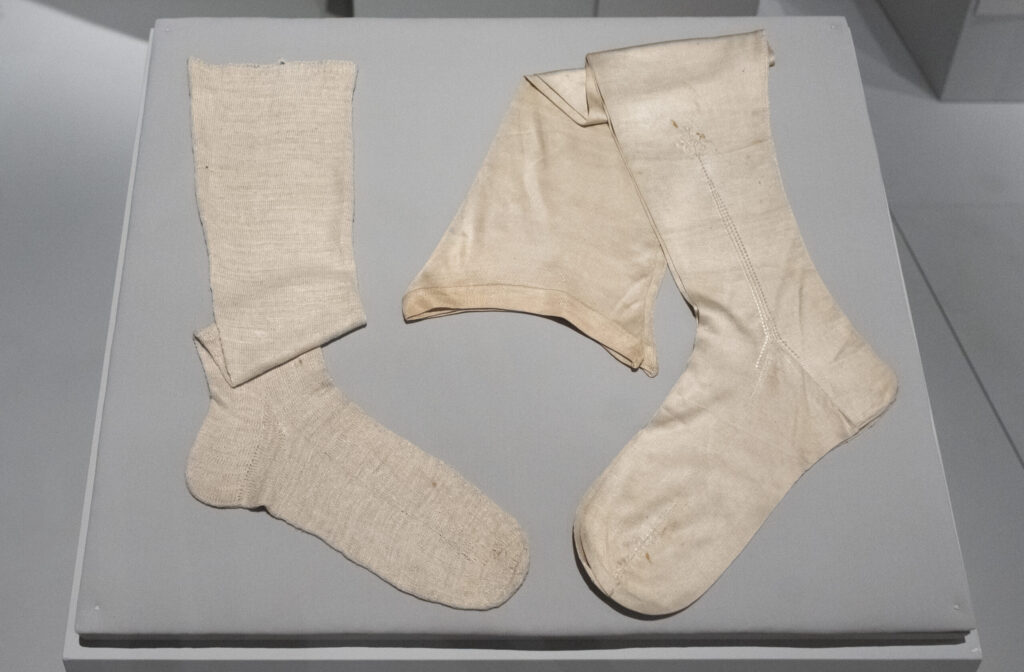
Two stockings sit side by side in a case. One is simple and hand-knitted, the other is one of a pair made with fine silk. In production and quality, they tell us two very different stories of knitting—and style—in the 18th century.
Knitting was so intrinsic to the daily life of women in the American colonies that references are scant in journals, diaries, and letters. The woman who knitted the lone stocking on the left of Figure 1 250 years ago remains anonymous. She probably hand-spun her linen yarn. She did not use the finest of steel knitting needles, or “pins” as they were called, which could be as small as one millimeter in diameter. Still, she produced a smooth stocking, working into the heel a squared box typical of the period. She even added a bit of decorative ribbing at the top.
This was a stocking made for everyday wear. At some time during the years that ensued, the stocking lost its mate, as often happens. Yet, it remains a testimony to this ubiquitous and continuous activity plied by women in New England. As part of their daily chores, women knitted linen, wool, cotton, and silk in plain, ribbed, and fancy styles with purled motifs for Sunday best. And when the stockings wore thin, women darned and “footed” them, replacing the heels to make them new again.
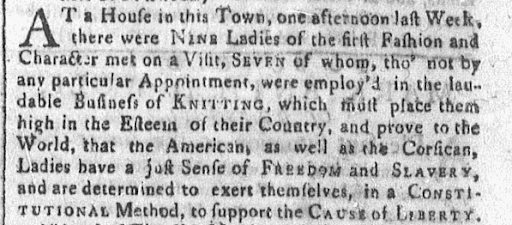
In the years just prior to and during the Revolutionary War, knitting acquired political overtones. The adoption of non-importation and non-consumption strategies by colonists in response to British tariffs effectively conscripted women to perform much of the labor of home production. “Knitting for liberty” became a call to duty as women gathered in highly publicized “bees” to spin fibers not only for weaving cloth, but also for knitting. In February of 1769, seven “Ladies of Fashion” in Newport met to support “the Cause of Liberty” by joining in “the laudable Business of KNITTING.”
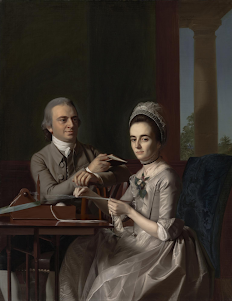
Knitting was a task not just for women of middling and working classes, but was also taken up by patriotic, well-to-do women. Sarah Morris Mifflin, a Philadelphia Quaker married to Major General Thomas Mifflin, wrote to a friend in Boston, “I have learnt to knit, and am now making stockings of American wool for my servants and this way do I throw my mite to the public good.” [i]
Harsh winter conditions and continuous campaigns during the war took a toll on soldiers’ clothing. Stockings were especially vital as without them soldiers were vulnerable to frostbite. During the winter at Valley Forge—the lowest ebb of the war—George Washington relayed to the Continental Congress the crisis of clothing among his soldiers, many of whom he called “almost naked.” Women in the colonies worked hard to alleviate shortages by spinning wool and linen and knitting as many stockings as possible for their husbands, brothers, and sons. Some women responded by unraveling old stockings to get enough fibers to re-spin and knit new socks and gloves. A few brave women rode to the front lines to deliver shirts, breeches, and woolen stockings.
Harsh winter conditions and continuous campaigns during the war took a toll on soldiers’ clothing. Stockings were especially vital as without them soldiers were vulnerable to frostbite. During the winter at Valley Forge—the lowest ebb of the war—George Washington relayed to the Continental Congress the crisis of clothing among his soldiers, many of whom he called “almost naked.” Women in the colonies worked hard to alleviate shortages by spinning wool and linen and knitting as many stockings as possible for their husbands, brothers, and sons. Some women responded by unraveling old stockings to get enough fibers to re-spin and knit new socks and gloves. A few brave women rode to the front lines to deliver shirts, breeches, and woolen stockings.
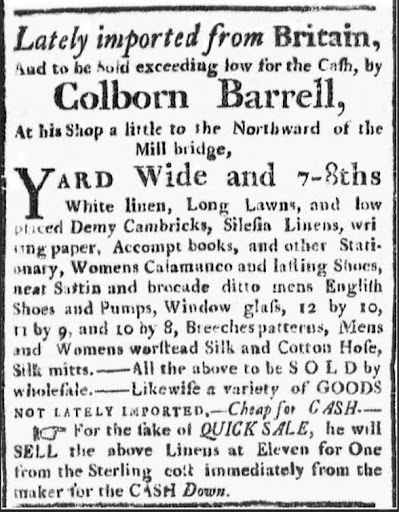
While residing at Valley Forge Headquarters, Mary Washington was frequently seen with needles, hand-knitting wool socks for soldiers. While her husband labored to provision his soldiers with warm wool stockings, he was also known to have ordered his own from London hosiers. Numerous merchant advertisements include references to imported stockings, or “hose.”
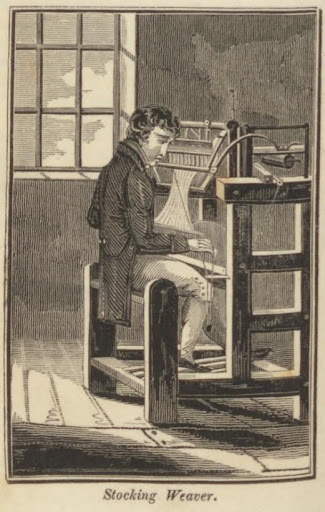
Imported stockings were produced on mechanized knitting looms, or “stocking frames,” an invention credited to William Lee of Cambridge, England in 1589. Improvements to the device in the 18th century increased not only the speed with which stockings were knitted, but also the fineness, especially when employing silk threads.
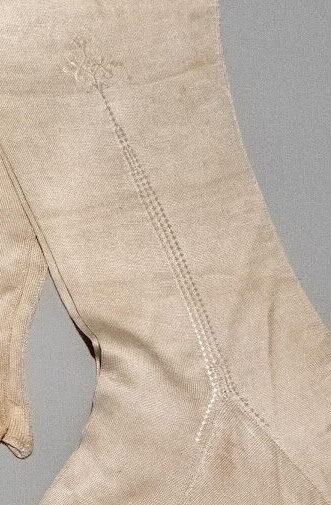
The technical achievements of the British stocking frame industry are illustrated in the elegant silk stockings that sit to the right of the homespun sock in Figure 1. The stitches are fine gauge and feature fancy patterning, called “clocking,” at the ankles.
Interestingly, these stockings were never worn. They were taken from the British merchant ship, Hannah, when it was captured south of Long Island in 1781 by the American privateer, Minerva, under the command of American Captain Dudley Saltonstall. The Hannah had been heading to British-controlled New York with a cargo of West Indian goods and gunpowder, valued at 80,000 pounds sterling. It became the largest maritime prize taken during the entire Revolutionary War. Particularly galling, the Hannah was also transporting personal supplies for the British officers stationed in New York City; among them was this pair of silk stockings. The loss of the Hannah spurred the British to retaliate at the Battle of Groton Heights and New London, Connecticut was almost leveled under the attacks of the newly traitorous General Benedict Arnold.
Lauren D. Whitley is the Curator of Historic Textiles and Clothing at Historic Deerfield.
[i] As quoted in Anne L. Macdonald, No Idle Hands: The Social History of American Knitting (New York: Ballentine Books, 1988), 33.