By Jeanne Solensky
Originally published in Historic Deerfield’s Summer 2026 Magazine.
Although no battle of the American Revolution occurred on Deerfield’s soil, the town experienced conflict of another sort. Scarred by external forces in the town’s early years, the community now saw danger within. A once close-knit village of residents bound together by blood, who practiced the same faith and farmed and served on town offices alongside one another, was torn asunder in the 1770s by the growing political crisis. Relatives and neighbors found themselves navigating a new divide, with some vocal and steadfast in their beliefs. Others were caught between sides, either unsure or unwilling to declare loyalties. Tensions continued to intensify and affected every single person throughout this small community.
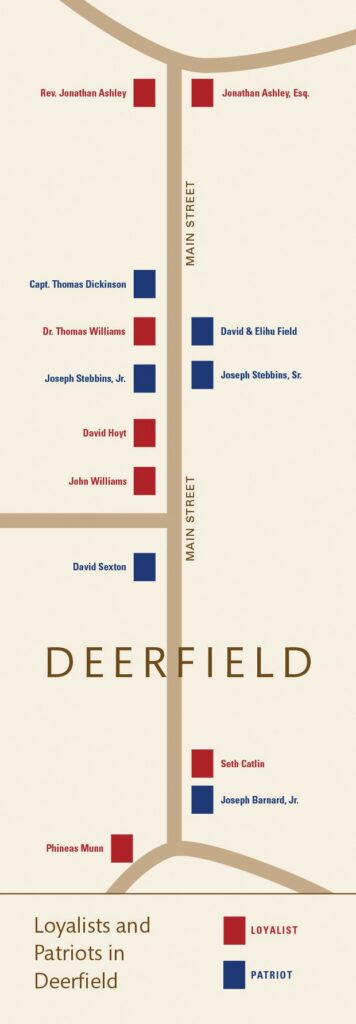
Fractures were evident by the time of the Boston Tea Party in December 1773. When news of the event arrived in Deerfield, Loyalists gathered at David Hoyt’s tavern in the Old Indian House on the town common to condemn the act, while Whigs celebrated at David Sexton’s tavern a few doors away. In the following years Whig mobs attempted to force Loyalists into switching sides yet stopped short of outright violence. When one group gathered outside Loyalist storekeeper John Williams’s house ready to break down his door, tavern keeper Seth Catlin brandished his musket from a second-floor window to prevent the action. Williams then deescalated the tense situation by inviting several men inside to debate the issue over glasses of flip (a sweetened, spiced liquor mixed with eggs); the once angry men departed in good spirits, inaccurately declaring their host a good Patriot. In 1781, Williams, along with Catlin, and Jonathan Ashley, Jr. (son of the Reverend Jonathan Ashley), led an effort in town to support peace negotiations with Great Britain that narrowly passed. Success was merely temporary: the General Court in Boston decreed this a seditious act and imprisoned the three men for several weeks.
Deerfield Whigs used other retaliatory measures against advocates of the Crown, as in the case of staunch Loyalist Reverend Jonathan Ashley, the town’s spiritual leader since 1732, who preached that the Lord was on the side of the King. Ashley’s hosting of a tea party in defiance of a boycott and refusal to announce fast days set by the provisional revolutionary government engendered further discord in town. The Whigs in charge reciprocated by withholding a portion of the minister’s salary and firewood allotment for several years, only restoring the amount in arrearage when Ashley’s executors filed a claim against the town after his death in 1780.
The political affinities of other residents were not as obvious, perhaps because of conflicting and changing loyalties. Elihu Ashley, second surviving son of Reverend Jonathan Ashley, adhered to his father’s politics when he and Seth Catlin prevented the town’s first Liberty Pole from being erected in July 1774. However, he was not as politically vocal as his father and brother and remained close friends with David Dickinson, who had encouraged him to saw the Pole in half, and Elihu Field, son of leading Whig David Field, who owned the store in front of which the second Liberty Pole was raised. Dickinson later served in the Continental Army and Field and David Hoyt, Jr., in the militia, the latter perhaps signaling the ambiguous loyalties of his tavern keeper father.
The opposing factions reunited after the Revolution thanks to longstanding ties that withstood the crisis. Existing and new marital bonds between families helped to heal the divisions: Jonathan Ashley, Jr. had been married to David Field’s daughter Tirza since 1771, and his sister Elizabeth married David Dickinson, Elihu Field’s brother-in-law, in 1783. Jail time did not prevent residents from electing Seth Catlin and John Williams to local offices after the war. Even Phineas Munn, Seth Catlin’s brother-in-law, was reintegrated into the community after a turbulent few years. The third man involved in the destruction of the first Liberty Pole, Munn was soon after attacked by a Whig mob and three years later fled to British General Burgoyne’s camp in New York and then to Canada. Munn was later captured in New Hampshire and sent to a Northampton jail. He returned to Deerfield in 1778 and lived there peacefully until his death in 1820.
Jeanne Solensky is Librarian at the Memorial Libraries.