by Leon Wiebers
As a recipient of Historic Deerfield’s Memorial Libraries Research Fellowship, I was thrilled to be able to access collections at Historic Deerfield and the Pocumtuck Valley Memorial Association (PVMA) to examine a variety of objects to be included in the forthcoming edition of the Survey of Historic Costume. As one of the new authors on this major book in the discipline, my time in Deerfield rewarded me with exceptional findings that represent both the library and museum collections.
My time in Deerfield kicked off in September 2025 with my attendance at Historic Deerfield’s fabulous Fall Forum, Fashioning the Body: Dress in New England 1600-1900, and viewing the exhibition, Body by Design: Fashionable Silhouettes from the Ideal to the Real. Connecting students and readers of Survey of Historic Costume to the homespun movement prior to the American Revolution became a germ of an idea from the Fall Forum. This symbolic form of economic protest in the hands, needles, and looms of women offered a story told by connecting the collections at Deerfield.
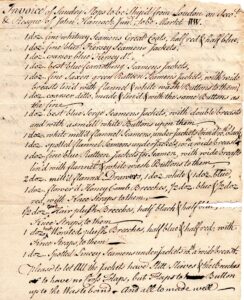
Several findings located in Memorial Libraries will inform my research for the Survey of Historic Costume. One example includes an invoice from 1760, which details a large amount of pre-made garments imported to the colony from Britain. This “Slop” clothing was usually considered cheaper and of inferior quality to tailor-made clothing of the time. (Fig. 1)
Another example is Epaphras Hoyt (1765–1850) recalling memories of life in Deerfield during the Revolution:
[Because of] “…deprivations caused by the war substitutes were found for calicos in stamped linen. Sheets which had become thin from use, were submitted to the process. Artists who had taken up the business, traveled about the country profering their services to families. They had wooden stamps prepared with various figures of vines, plants and other devices such as might please the eye. The colors used were various, but often no other than the juice of the elder berry, perhaps prepared by some mordant to render it more durable; but the colors were miserably defective at the best. Into the coloring matter the stamp was dipped, and then imprinted on the sheet, smoothly stretched for the process. The work was not very expensive. In this dress, we often saw our sprightly females proudly flaunting in their home made calico. But like the feathers of some of our brilliant summer birds, the colors soon faded and left the receiver with the sad remembrance of its precious beauty.” [i] (italics added by blog author)
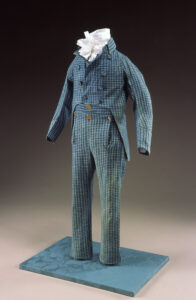
Additionally, the young boy’s suit of clothes (1800–1815) in Historic Deerfield’s collection reveals a skill in weaving and making, yet one that could not compete with the vast textile industry established in Britain at this time. (Fig. 2)
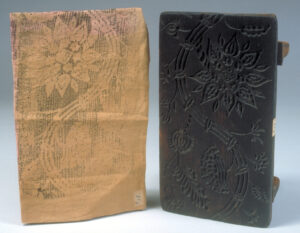
This story of industrious, patriotic, innovative work completed mostly by women celebrates their work towards becoming a new country yet reveals the limitations. The textile woodblocks used to print fabrics of the time added a tangible and visible quality to the dress of these industrious women. (Fig. 3) These and other objects from the collections will be included in the new, 8th edition of the book for students and readers all over the country.
The support of the Memorial Libraries Research Fellowship has also inspired a new path of research for consideration. The astonishing women of Deerfield who renovated, revived, and researched the town and their inhabitants to create a place of historical tourism, the Arts and Crafts movement, and the Colonial Revival deserve closer examination of their dress, adornment, personal spaces, and gender identities. While much has been written and said about C. Alice Baker (1833–1909), she remains a somewhat enigmatic character. Eschewing eccentricities and costliness in dress, she wrote to her cousin George Sheldon:
“[E]very man’s and woman’s position in the world is greatly dependent upon his surroundings and in order to win any recognition as a ‘lady’ I must keep up in some measure to the required standard – I must not dress worse than my pupils or affect Thoreauish eccentricities of dress or living – To do this costs money – more than I wish or am willing to spend.” [ii]
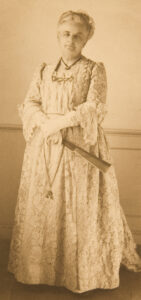
However, she was ready to dress up for the camera frequently and document this publicly with a grand ball! (Fig. 4) More is yet to be uncovered.
Thank you to all the partners at Historic Deerfield, PVMA, and the amazing Memorial Libraries.
Leon Wiebers is a professor of costume design at Loyola Marymount University and the current president of the Costume Society of America.
[i] Epaphras Hoyt, Recollections of Times and Things in my Early Life, 1839. Historic Deerfield Library.
[ii] C. Alice Baker, Letter to George Sheldon, May 22, 1876. PVMA Library.