"Put Your Best Building Forward"
by Brece Honeycutt
put your best building forward
dawn road:
phosphorescent fog auras
glow, golden yellow cleared to crimson
paleness grew into puce, buildings manifested
ordered orchestration, dulled out drabness
brightness as advertising
dusk road:
glimmer shimmer twilight
villages pressed up against the road
buildings loomed large
rigorous voices, blazing orbs
ignited fervor
coda:
a ball of Saint Elmo’s fire
a hurrycane of gifts
a vaporized state
a sublime[i]
[i] put your best building forward, Brece Honeycutt prismatic utopia: poems, (an unpublished poetry manuscript), 40. Calvin Green wrote of ‘ball lightning” known as “St Elmo’s fire” which occurred during a “mid-January 1817 winter storm.” Glendyne R. Wergland and Christian Goodwillie, editors, Shaker Autobiographies, Biographies and Testimonies 1806-1907, “Calvin Green, ‘Biographic Memoir of the Life and Experience of Calvin Green (1861),’ (Brookfield, VT: Pickering and Chatto, 2014), FN 227, pp. 292-3.
The Approach
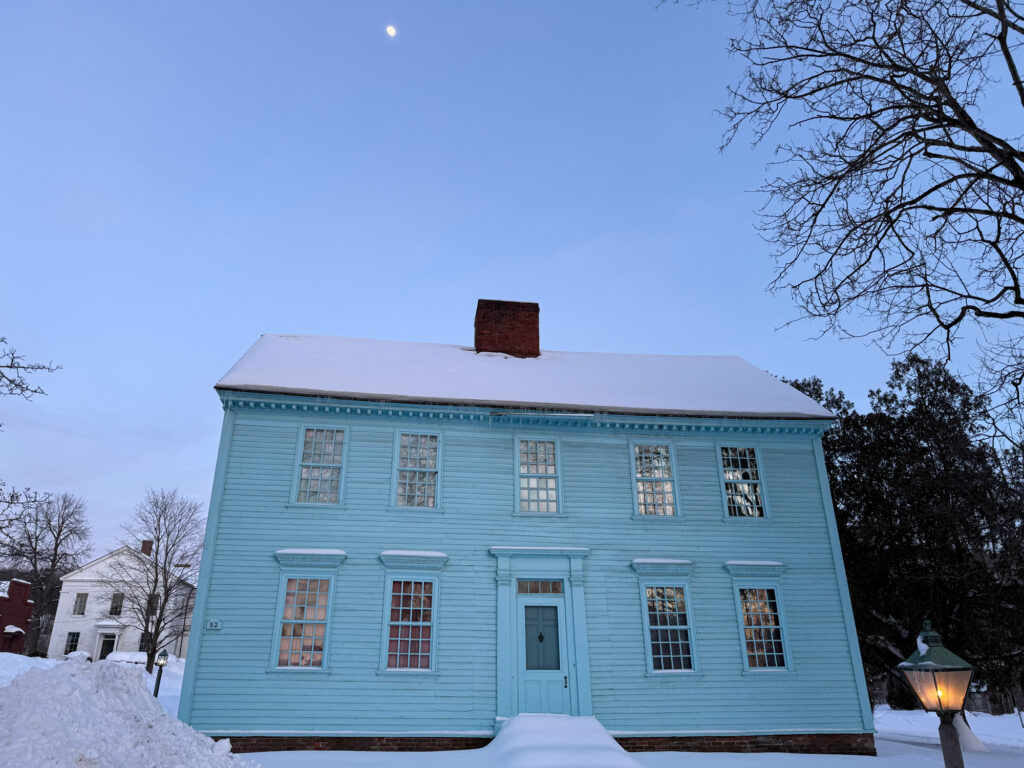
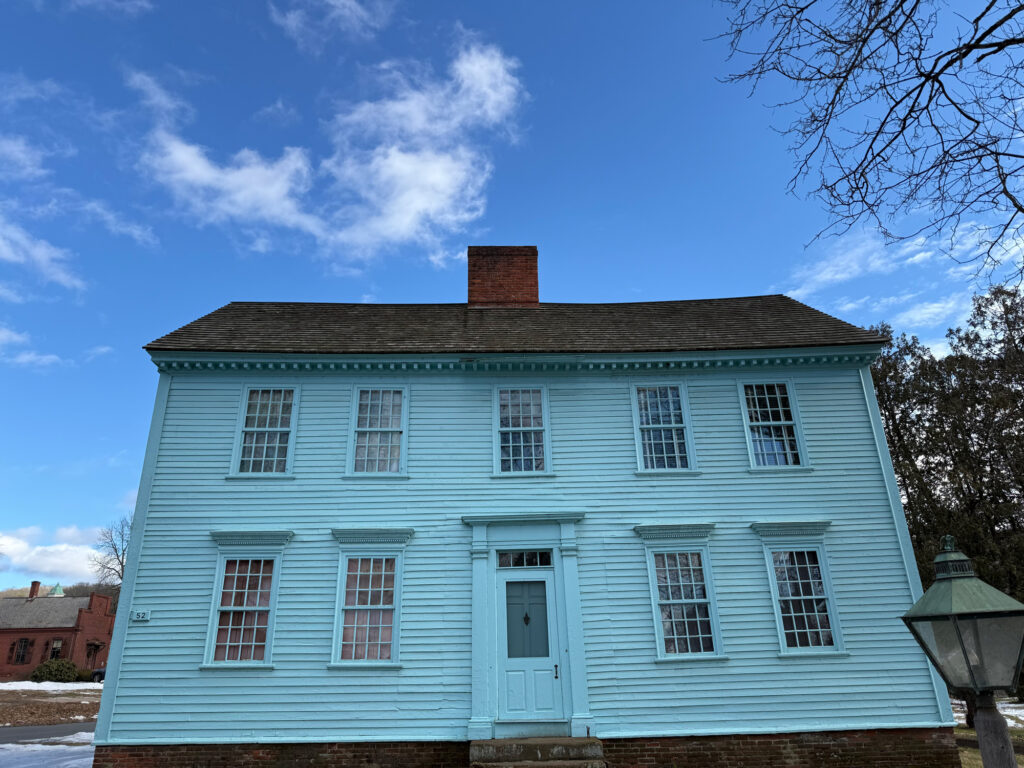
For four weeks in January, 2026, I turned right at the Prussian blue clapboard house en route to Historic Deerfield’s Memorial Libraries. The Wells-Thorn house appears more turquoise instead of deep night-sky Prussian blue, nonetheless, one can’t miss its painted glory.[i] Paint and color were on my mind each day during my Library Fellowship as I read color- and paint-related books found in the Stephen L. Wolf Collection. I was on a quest to situate the Shakers’ use of paint and color alongside their 19th-century contemporaries.[ii]
It wasn’t just the reading, but also the walking; a fortuitous combination. Most mornings began with a dawn walk up one side and down the other of Deerfield’s Old Main Street. An entire month where snow fell in measurable quantities, ice froze on paths and blue skies beckoned me forth.
How did each building appear in the morning sun; against a snowed landscape; as the sun set low on the horizon? Were the buildings of one architectural style or many? Did the structure sit close to the road, behind a fence or stare out of many windows? Were structures constructed from clapboard or brick, in the 18th or 20th century, painted in bright or drab colors?
John W. Masury, a paint manufacturer in Brooklyn, provided a method for my observations from the 1868 Hints on House-Painting; or, Paint and Colors and how to use them: “Every house, barn, outbuilding, or fence becomes, when painted, a more conspicuous object in the landscape than it otherwise would be;”[iii] How was my striding through ‘contemporary’ Historic Deerfield any different for those coming into 19th-century New Lebanon, a Shaker village in upstate New York with conspicuously painted structures?
Many wrote about approaching Shaker villages, by way of a turnpike or a thoroughfare; roads bisected these villages, literally running right through the center. Perfectly straight parallel fences defined the village perimeters on both sides. Trekkers were able to see into the village through the white painted fences, but not walk around inside the village proper. Shakers literally put their best buildings forward with workshops painted yellow ochre and meeting houses painted white.[iv]
Regulations regarding painted buildings are found within the Shakers’ 1845 Millennial Laws; Section IX “Concerning Building Painting and Varnishing,” states “It is unadvisable for wooden buildings, fronting the street, to be painted red, brown or black, but they should be of a lightish hue” and continues, “Barns and back buildings, as wood houses, etc, if painted at all should be of a dark hue, either red or brown, lead color or something of the kind, unless they front the road, or command a sightly aspect, and then should be of a very light color.”[v]
Shakers were painting barns and woodsheds, far from the road, darker colors, to fall away from the eye and by contrast, painting those by the road, lighter colors “to command a sightly aspect.” Utilizing these same concepts seventy-five years later, Bonnie Snow and Hugo B. Froehlich state: “he must know which colors are advancing and which are ‘retreating’ in their effect upon the eye and the mind. He must understand that dignity and seriousness, lightness and joy, tragedy and sorrow, may be suggested by colors, as well as by words. We must not forget that harmony is possible through the use of pure colors.”[vi]
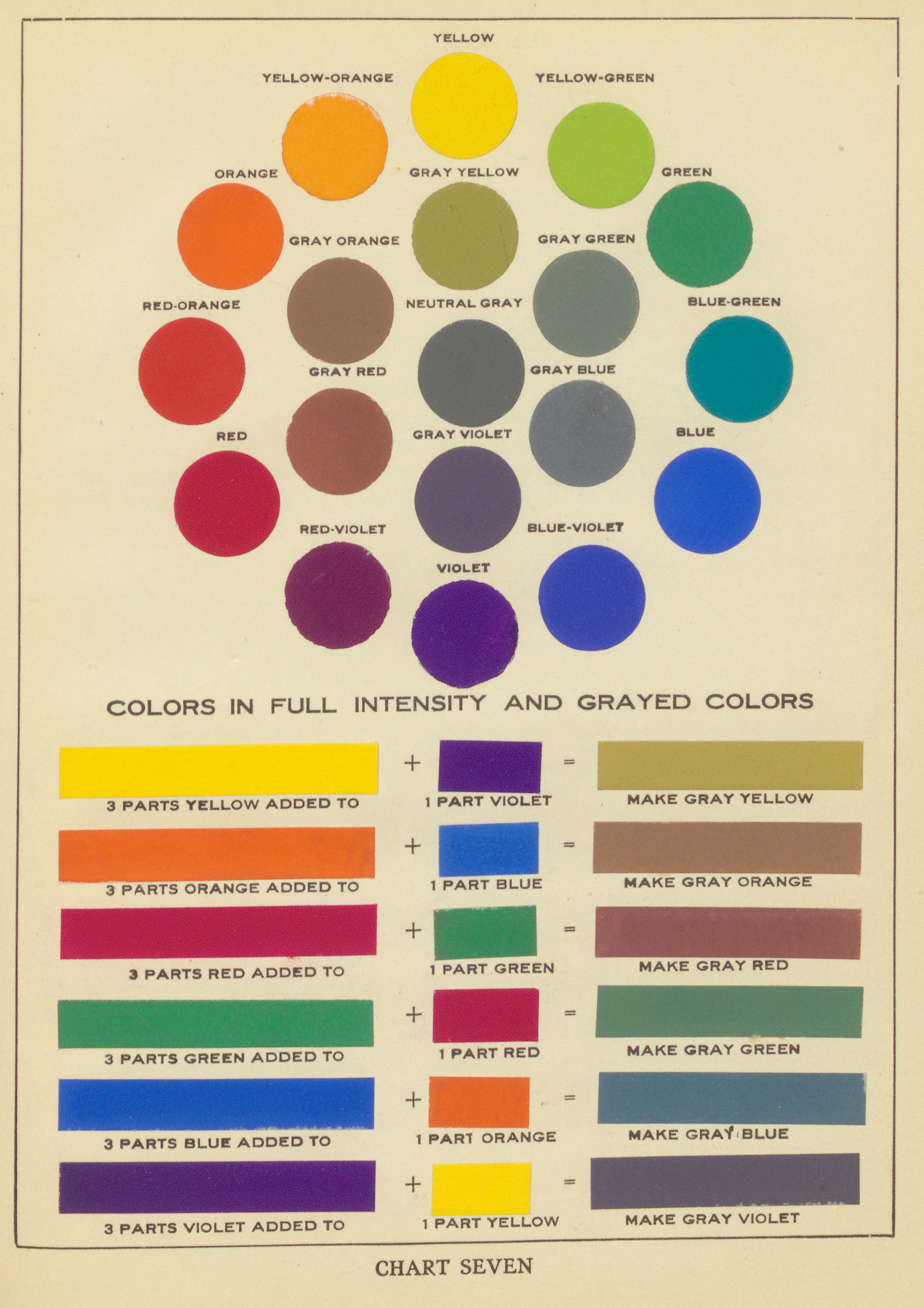
Snow and Froehlich’s 1920 book, Theory and Practice of Color, provides both basic and analytical color theories, delves into the meanings of colors, serves as a practical guide for paint usage in interiors and exteriors, and, demonstrates how colors affect the human mind and senses. They posit the use of color found in commercial design, likening its uses as advertisement on billboards and posters, “Designers discovered that simple flat shapes and a few colors well-arranged could be seen farther than shapes that were treated to represent details…. for the advertiser’s purpose.”[vii]
Points of View
By placing brightly colored buildings next to the road, were Shakers advertising their communities? Perhaps, they realized, “Color is the first impression received from our surroundings, and is therefore the most important factor in art and industry,” as posited by Charles Julius Jorgensen in 1906. [viii] Thomas Merton noted of the Shakers, “Their only advertisement was the work itself; and the honesty with which the product was set before the buyer.”[ix] Whilst Merton speaks of chairs and baskets, a Shaker constructed village, an entire entity in itself, was precisely ‘the work itself.’
The color scholar and consultant Faber Birren states, “One must remember that color is more compelling than neutrality. Hence, if it is strategically applied, it can make order out of chaos, distinguish important from unimportant elements.”[x] Was it strategic to put lighter painted buildings near the road?
In Autumn of 1819, Benjamin Sillman rode through New Lebanon recounting: “Their [Shaker] buildings are closely arranged, along a street of a mile in length. All of them are comfortable, and a considerable proportion are large. They are, almost without exception, painted of an ochre yellow, and although plain, they make a handsome appearance. The utmost neatness is conspicuous in their fields, gardens, courtyards, out houses, and in the very road; not a weed, not a spot of filth, or any nuisance is suffered to exist.”[xi] Sillman noted not only the conditions found in the village, but also the exact paint color.
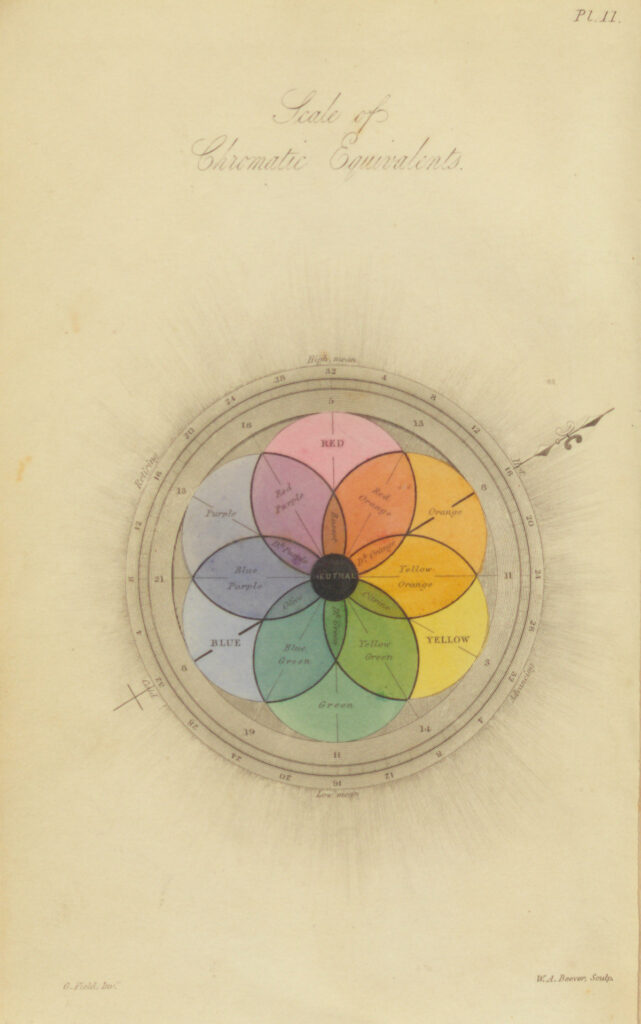
In 1869, George Field writes “white is the most advancing of all colors in a picture and produces the effect of throwing other colours back in different degrees, according to their specific retiring or advancing power.”[xii] He noted that ‘yellow is the most advancing color….of great power in reflecting light.”[xiii] In my mind’s eyes, these Shaker buildings, large blocks of “ochre yellow” pressed up against the road, become early billboards for their built environment; an advertisement for their orderly, clean and painted village.
Second Approach
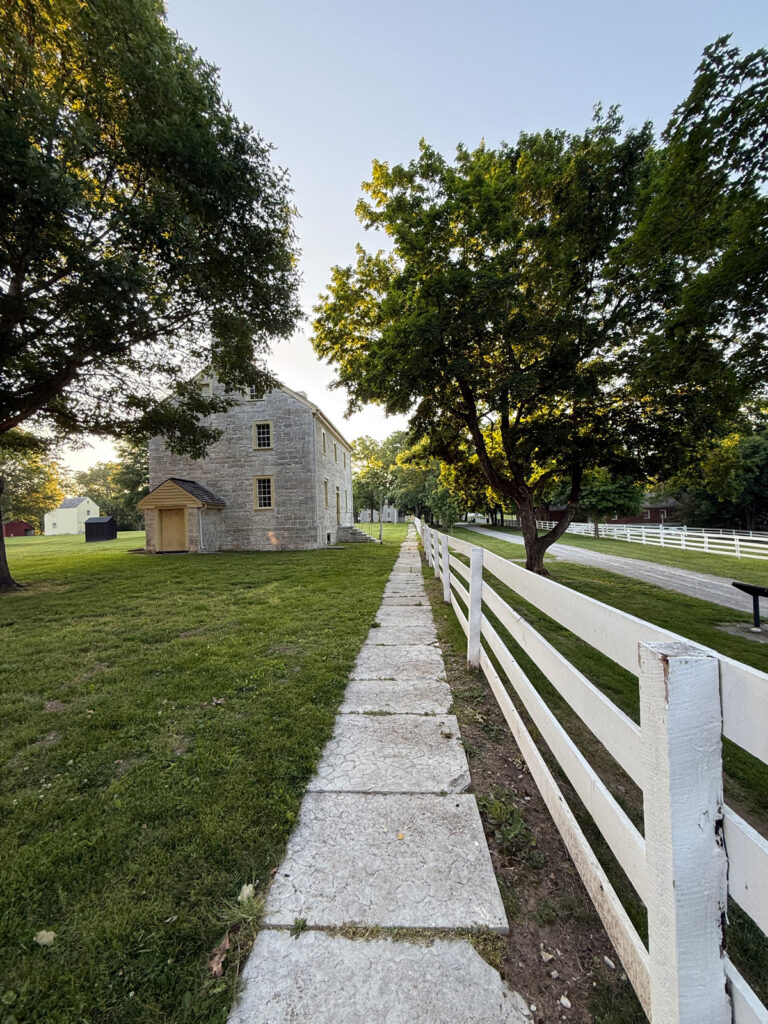
In late May, I found myself walking up and down the turnpike of the former Pleasant Hill Shaker community in Harrodsburg, Kentucky.[xiv] Fences lined both sides, separating the village from the road with sidewalks situated inside the fences.
Up early, I purposefully stayed within the village proper, meaning I sauntered alongside the buildings, the white planked fences separating me from the turnpike. From these vantage points, I saw the Brethren’s Bath house (1860) cast its teeny shadowed shape upon the yellow clapboarded Water House; watched as the orange-pink sun rays literally entered the east meeting room windows of the grey-white limestone Great Dwelling (1824-34); and witnessed glowing yellow light inflame the white clapboarded Meeting House (1820) windows across the turnpike.
Contrasting Viewpoints
Faber Birren noted, “Not only is a properly balanced light a prerequisite for all things, but the color of the light, the character of the environment, the stimulation of the senses (or lack thereof) are all vital to normal life, as well as, to survival itself.”[xv]
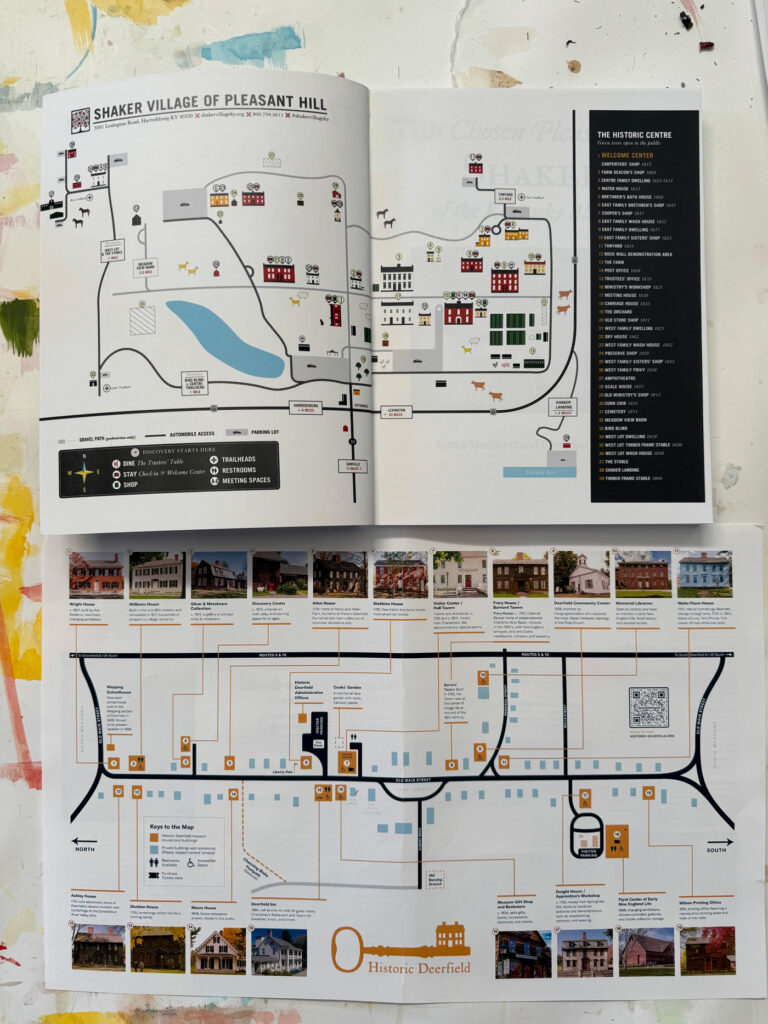
How could I know that daily walks through Historic Deerfield would school me to fully understand Shaker village construction? Nor did I realize, reading books by 20th-century color scholars, Birren, Snow & Froelich, Jorgensen and Burris-Meyer, literally put the Pleasant Hill village into perspective, resulting in the realization of completeness, of an entire entity even in a village bisected by a turnpike.
About the Author
Brece Honeycutt is an independent scholar, multimedia artist, and poet. In January 2026, she spent time researching books in the Wolf Collection as a recipient of a Memorial Libraries Research Fellowship. Visit her website at brecehoneycutt.com.
[i] Wells-Thorn house built in 1751. Painted ‘sky blue’ around 1800 using the pigment Prussian blue.
[ii] For a full report on my research regarding the Shakers use of paint and color, please read my article, Prismatic Utopia, American Communal Societies Quarterly, Vol. 20, no. 3, July 2026, The Richard W. Couper Press, Hamilton College Library, 131-176.
[iii] J. W. Masury, Hints on House-Painting; or, Paint and Colors, and how to use them, (Masury & Whiton Paint Manufacturers,1868), 16.
[iv] Glendyne Wergland, editor, Visiting the Shakers, 1778-1849: Watervliet, Hancock, Tyringham, New Lebanon. (Richard W. Couper Press, Clinton, NY :2007). Wergland assembled countless accounts of people encountering Shaker villages.
[v] Edward Deming Andrews, The People Called Shakers; A Search for the Perfect Society, (New York: Oxford University Press, 1953), 285.
[vi] Snow, Bonnie and Hugo B. Froehlich, The Theory and Practice of Color (New York: Prang, 1920), 57.
[vii] Snow, 55.
[viii] Charles Julius Jorgensen, The Mastery of Color: A simple and perfect color system based upon the spectral colors, for educational purposes and Practical Use in the Arts and Crafts, Vol. 1 & Vol II, (Milwaukee: published by the author, 1906), 14.
[ix] Thomas Merton, Seeking Paradise: The Spirit of the Shakers, edited with an introduction by Paul M. Pearson, (Maryknoll, NY: Orbis books), 79-80.
[x] Faber Birren, Light Color and Environment, (New York: Van Nostrand Reinhold Co: 1969), 81.
[xi] Wergland, 175.
[xii] George Field, Chromatography: A Treatise on Colours and Pigments and their Powers in Painting, (London: Winsor & Newton, 1869), 118.
[xiii] Field,118.
[xiv] The Shaker Village of Pleasant Hill may be visited today. https://shakervillageky.org/
[xv] Faber Birren, Light, Color and Environment, (New York: Van Nostrand Reinhold Co, 1969), 7.