The Flynt Center and historic houses are closed until April 18, 2026.
WINTER EVENTS

January 21, 2026 Leon Wiebers

Mining Collections for Dress History in Deerfield

by Leon Wiebers

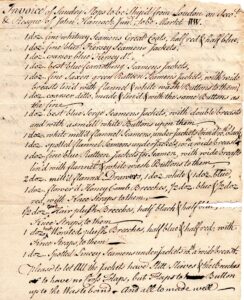
Fig. 1: Invoice of Sundry Slops to be Ship’d from London….1760. Historic Deerfield Library.

As a recipient of Historic Deerfield’s Memorial Libraries Research Fellowship, I was thrilled to be able to access collections at Historic Deerfield and the Pocumtuck Valley Memorial Association (PVMA) to examine a variety of objects to be included in the forthcoming edition of the Survey of Historic Costume. As one of the new authors on this major book in the discipline, my time in Deerfield rewarded me with exceptional findings that represent both the library and museum collections.

My time in Deerfield kicked off in September 2025 with my attendance at Historic Deerfield’s fabulous Fall Forum, Fashioning the Body: Dress in New England 1600-1900, and viewing the exhibition, Body by Design: Fashionable Silhouettes from the Ideal to the Real. Connecting students and readers of Survey of Historic Costume to the homespun movement prior to the American Revolution became a germ of an idea from the Fall Forum. This symbolic form of economic protest in the hands, needles, and looms of women offered a story told by connecting the collections at Deerfield.

Several findings located in Memorial Libraries will inform my research for the Survey of Historic Costume. One example includes an invoice from 1760, which details a large amount of pre-made garments imported to the colony from Britain. This “Slop” clothing was usually considered cheaper and of inferior quality to tailor-made clothing of the time. (Fig. 1)

Another example is Epaphras Hoyt (1765–1850) recalling memories of life in Deerfield during the Revolution:

[Because of] “…deprivations caused by the war substitutes were found for calicos in stamped linen. Sheets which had become thin from use, were submitted to the process. Artists who had taken up the business, traveled about the country profering their services to families. They had wooden stamps prepared with various figures of vines, plants and other devices such as might please the eye. The colors used were various, but often no other than the juice of the elder berry, perhaps prepared by some mordant to render it more durable; but the colors were miserably defective at the best. Into the coloring matter the stamp was dipped, and then imprinted on the sheet, smoothly stretched for the process. The work was not very expensive. In this dress, we often saw our sprightly females proudly flaunting in their home made calico. But like the feathers of some of our brilliant summer birds, the colors soon faded and left the receiver with the sad remembrance of its precious beauty.” [i] (italics added by blog author)
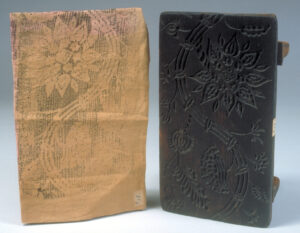
Fig. 3: Calico hand stamps, c. 1775. Courtesy of Pocumtuck Valley Memorial Association’s Memorial Hall Musuem, Deerfield, MA 1882.073.01.

Additionally, the young boy’s suit of clothes (1800–1815) in Historic Deerfield’s collection reveals a skill in weaving and making, yet one that could not compete with the vast textile industry established in Britain at this time. (Fig. 2)

This story of industrious, patriotic, innovative work completed mostly by women celebrates their work towards becoming a new country yet reveals the limitations. The textile woodblocks used to print fabrics of the time added a tangible and visible quality to the dress of these industrious women. (Fig. 3) These and other objects from the collections will be included in the new, 8th edition of the book for students and readers all over the country.

The support of the Memorial Libraries Research Fellowship has also inspired a new path of research for consideration. The astonishing women of Deerfield who renovated, revived, and researched the town and their inhabitants to create a place of historical tourism, the Arts and Crafts movement, and the Colonial Revival deserve closer examination of their dress, adornment, personal spaces, and gender identities. While much has been written and said about C. Alice Baker (1833–1909), she remains a somewhat enigmatic character. Eschewing eccentricities and costliness in dress, she wrote to her cousin George Sheldon:

“[E]very man’s and woman’s position in the world is greatly dependent upon his surroundings and in order to win any recognition as a ‘lady’ I must keep up in some measure to the required standard – I must not dress worse than my pupils or affect Thoreauish eccentricities of dress or living – To do this costs money – more than I wish or am willing to spend.” [ii]

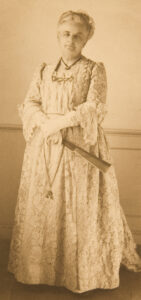
However, she was ready to dress up for the camera frequently and document this publicly with a grand ball! (Fig. 4) More is yet to be uncovered.

Thank you to all the partners at Historic Deerfield, PVMA, and the amazing Memorial Libraries.
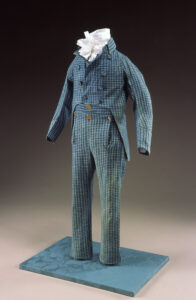
Fig 2: Boy’s homespun suit, blue-and-white checked cotton, 1800-1815. Historic Deerfield, 2005.4.
Fig. 4: Photo of C. Alice Baker in an 18th century gown, 1892. Historic Deerfield, 2009.5.

Leon Wiebers is a professor of costume design at Loyola Marymount University and the current president of the Costume Society of America.

[i] Epaphras Hoyt, Recollections of Times and Things in my Early Life, 1839. Historic Deerfield Library.

[ii] C. Alice Baker, Letter to George Sheldon, May 22, 1876. PVMA Library.
February 3, 2020 Ned Lazaro

Wearable Gardens: Nature Embellishes the Human Figure

By Ned Lazaro
Curator of Textiles

The depiction of flowers to decorate and embellish textiles has been an integral part of clothing for thousands of years. Where actual flowers wilt and die, realistic and stylized representations on fabric copying flower colors and shapes, and symbolizing life and renewed growth, survive. Mirroring a growing interest in plants and gardens, the appearance of flora on textiles likewise increased and diversified.[1] Eighteenth-century textiles worn for dress display some of the most elaborate and beautiful examples of flora, both real and stylized. Woven, embroidered, painted, and printed flowers depicted on clothing reveal the genre’s popularity. They delighted the eye, conjured faraway lands, and illustrated humankind’s attempts to harness fleeting beauty onto the human form.

Woven Flora

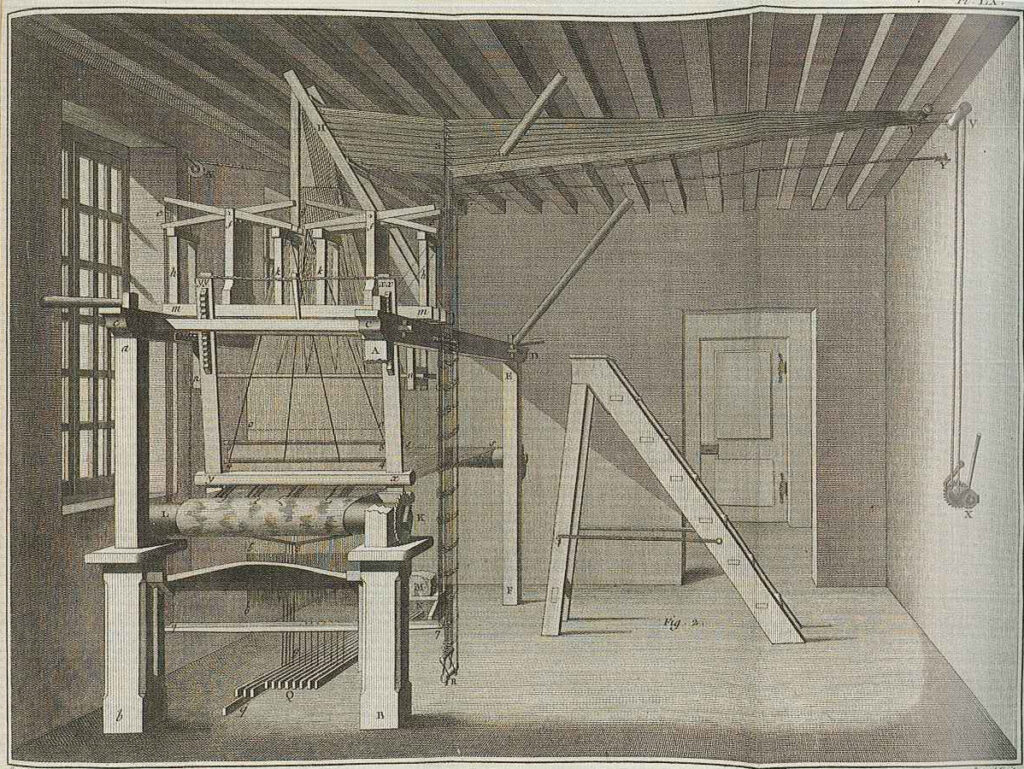
The eighteenth century’s drawloom allowed for unparalleled and realistic representations of flowers in woven textiles (Fig. 1). Floral patterns were first drawn out by specialized designers who found inspiration in nature, gardens, and the work of other artists. Some also received academic training.[2] Successful designers had an understanding of what was possible for master weavers to create using a complicated loom that bound warp and weft threads in a myriad of ways.

Fig.1, Bernard Direxit (engraver). “Soierie, Etoffes Brochées. Élévation Perspective du Métier pour Fabriquer les Etoffes Brochées garnide tous les cordages et Agrets.” Denis Diderot, Recueil de planches, XI, pl. LX.

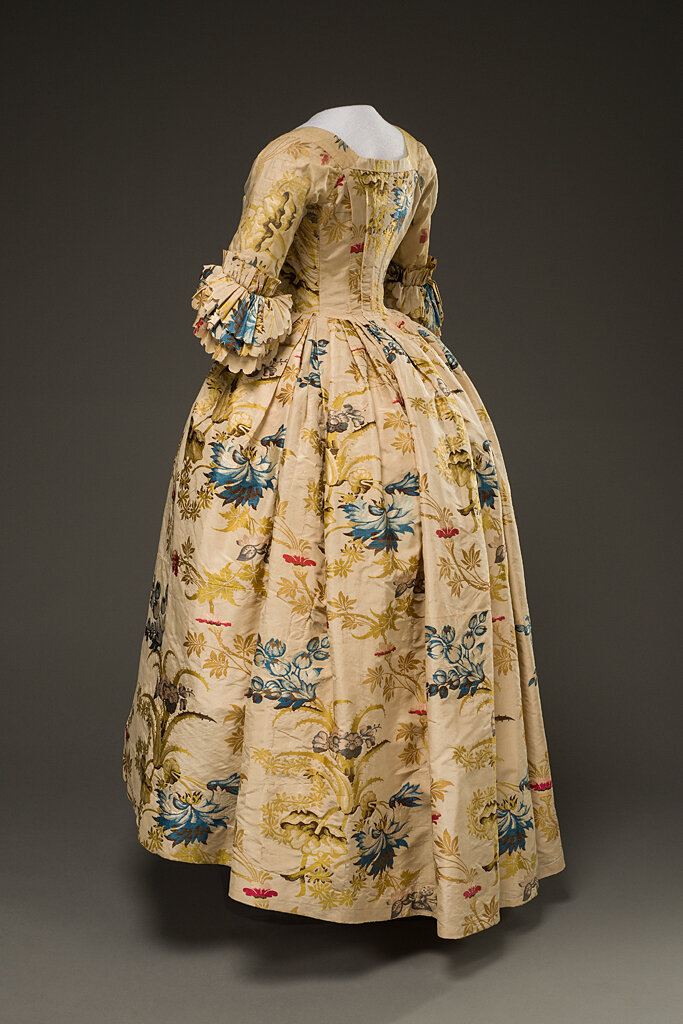
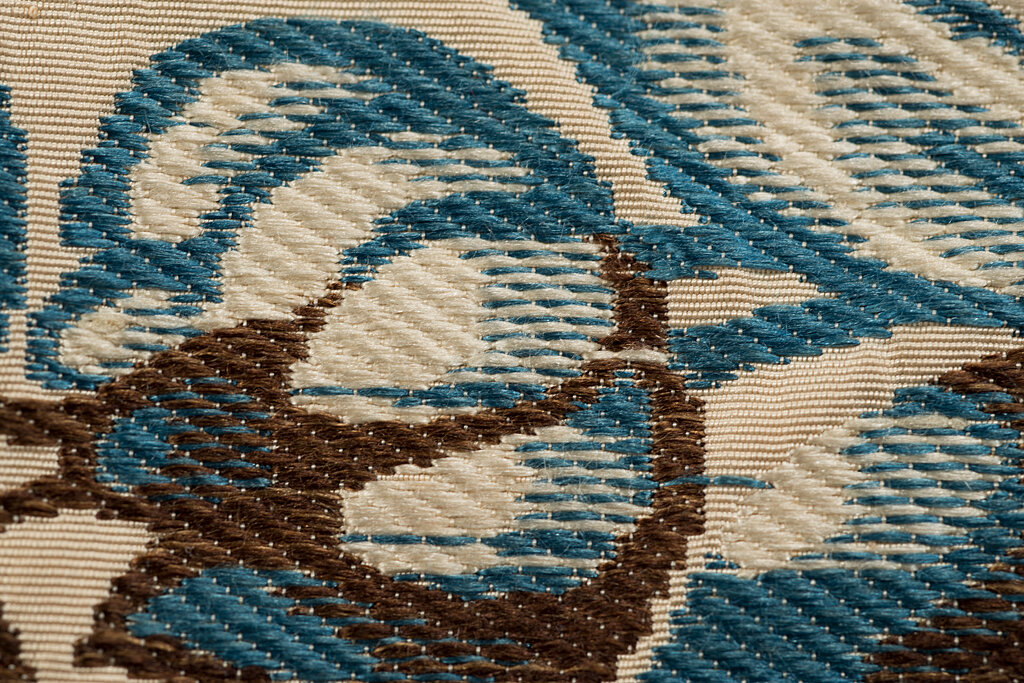
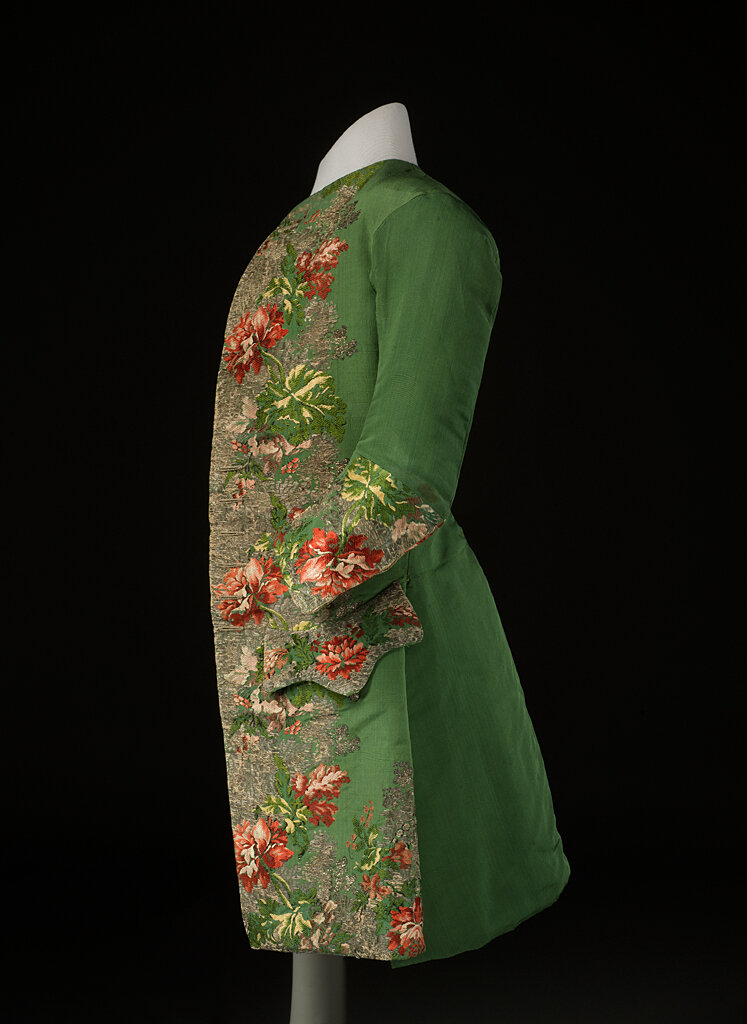
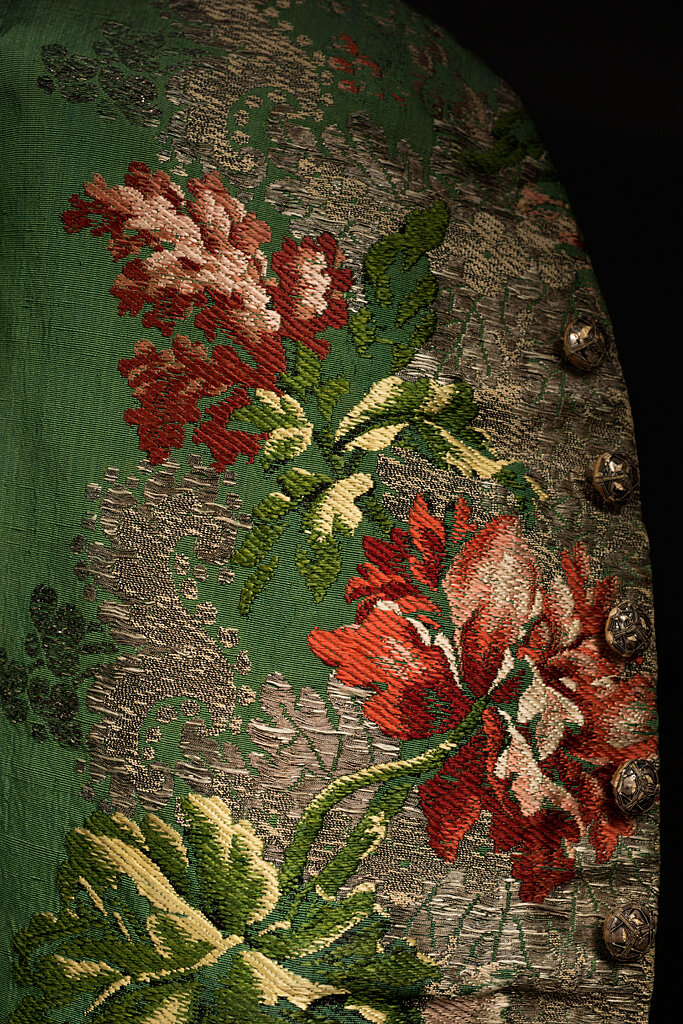
These artists also paid attention to fashion, usually emanating from France, with current trends and the relentless desire for novelty leading the way. One such trend began in the 1730s. At that time, French and English weavers began depicting flowers more realistically. Artistic improvements in the weaving of brocaded silks created an effect known in French as points rentrés, adding shading, and therefore depth, to flowers, buds, and fruit (Fig. 2a, b) by interlocking brocading threads.[3] Motifs grew considerably in size as the vogue for more detailed and lifelike flowers became possible. Large, asymmetrically repeating motifs, as well as secondary or background designs, also created the illusion of realism, echoing the imperfections of nature. The inclusion of metallic thread further heightened the allure of these flowers (Fig. 3a, b). When new, these untarnished metallic elements reflected candlelight in the evening, illuminating dark interiors and captivated onlookers.

Fig. 2a, b. Gown and detail, England (Spitalfields), woven from a design by Anna Maria Garthwaite (1690-1763), c.1743. Polychrome, weft-patterned silk (brocade) patterning; off-white, plain-weave silk. F.098.
Fig. 3a, b. Waistcoat and detail, probably Lyon, France, 1730s-1740s. Polychrome, weft-patterned silk and metal (brocade) patterning; green, plain-weave ribbed silk. F.191.

Embroidered Flora

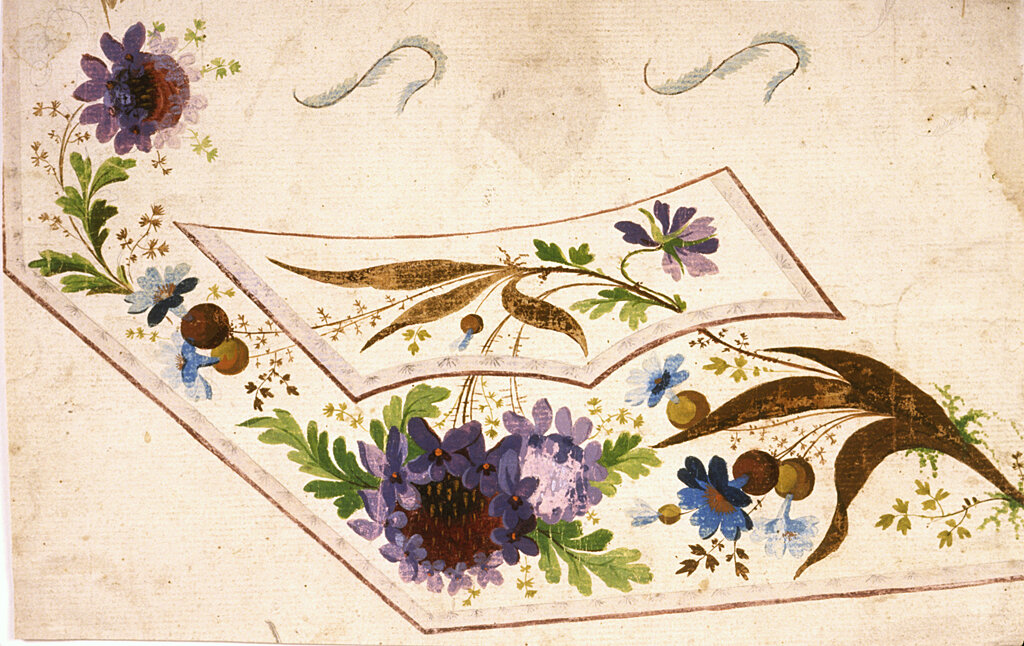
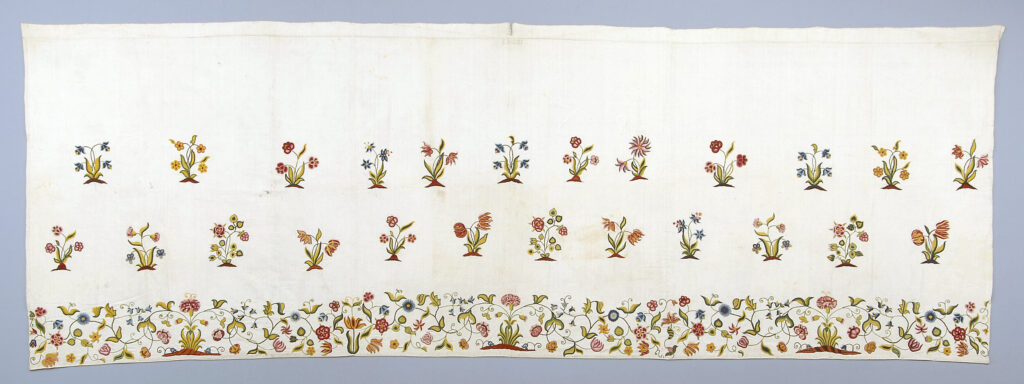
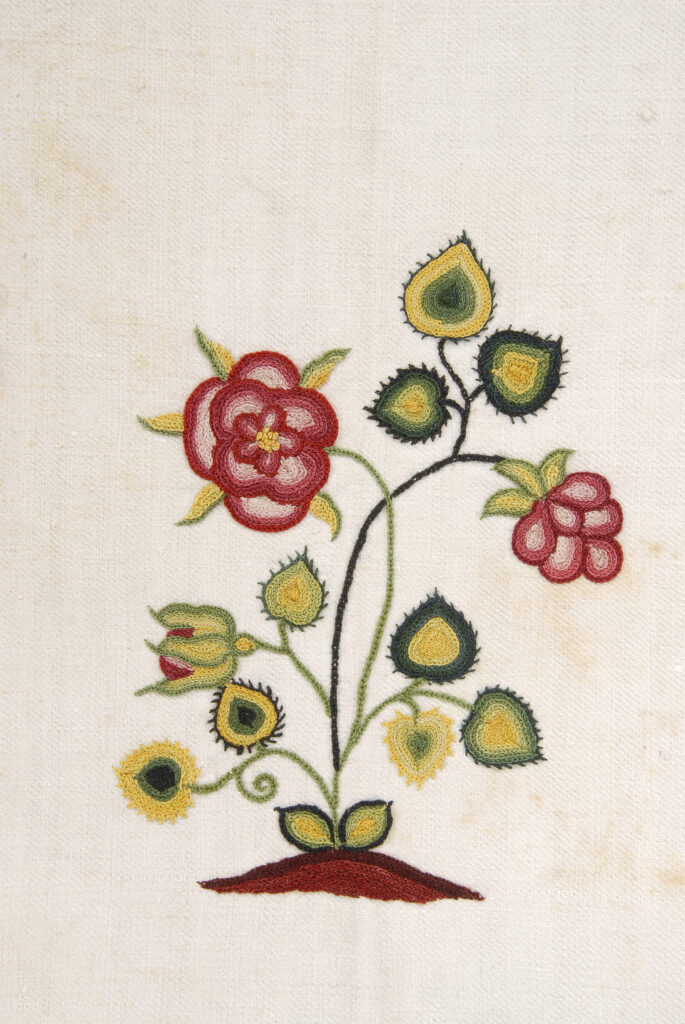
Embroidery is the process of using a needle to add design to an already-woven fabric or other ground (such as leather). Embroidery was uniquely suited to represent flowers in the eighteenth century; a needle and thread could easily create small, detailed motifs in ways ordinary weaving could not achieve (Fig. 4). Embroidery also allowed for a higher degree of individualization in designs not possible with weaving (Fig. 5a-c).

Fig. 4. Waistcoat pattern, England or France, 1770s. Gouache paint; laid paper. Mr. and Mrs. Hugh B. Vanderbilt Fund for Curatorial Acquisitions, 2001.48.1.
Fig. 5a-c. Petticoat and details, probably England, 1721. Polychrome, two-ply worsted embroidery (crewel); white, twill-weave linen and cotton (fustian) ground. Museum Collections Fund, 2007.5.

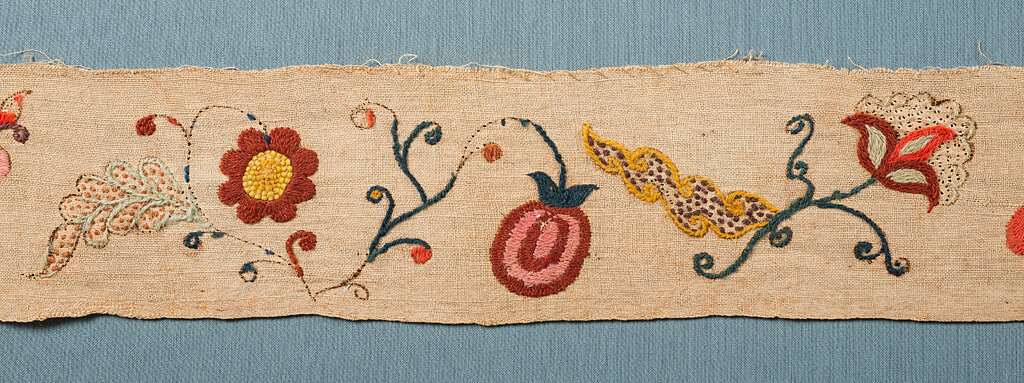
Like weaving, formal instruction in embroidery guilds in England and France was almost exclusively for men. However, women had the chance to embellish their appearance, and that of a loved one, through embroidery done in more informal settings such as the home, or taught as an ornamental art at a school. The mastery of stitches could later serve as a creative outlet for some women to embellish items of clothing such as petticoat hems (Fig. 6). Regardless of the context of training, skilled embroidery and a variety of stitches created nuanced shading and texture that added to a floral motif’s lifelike qualities.

Fig. 6. Petticoat hem detail, possibly American, mid-late 18th century. Polychrome, two-ply worsted embroidery (crewel); off-white, plain weave linen. Gift of Jane Dow Bromberg, 86.088.

Painted and Printed Flora

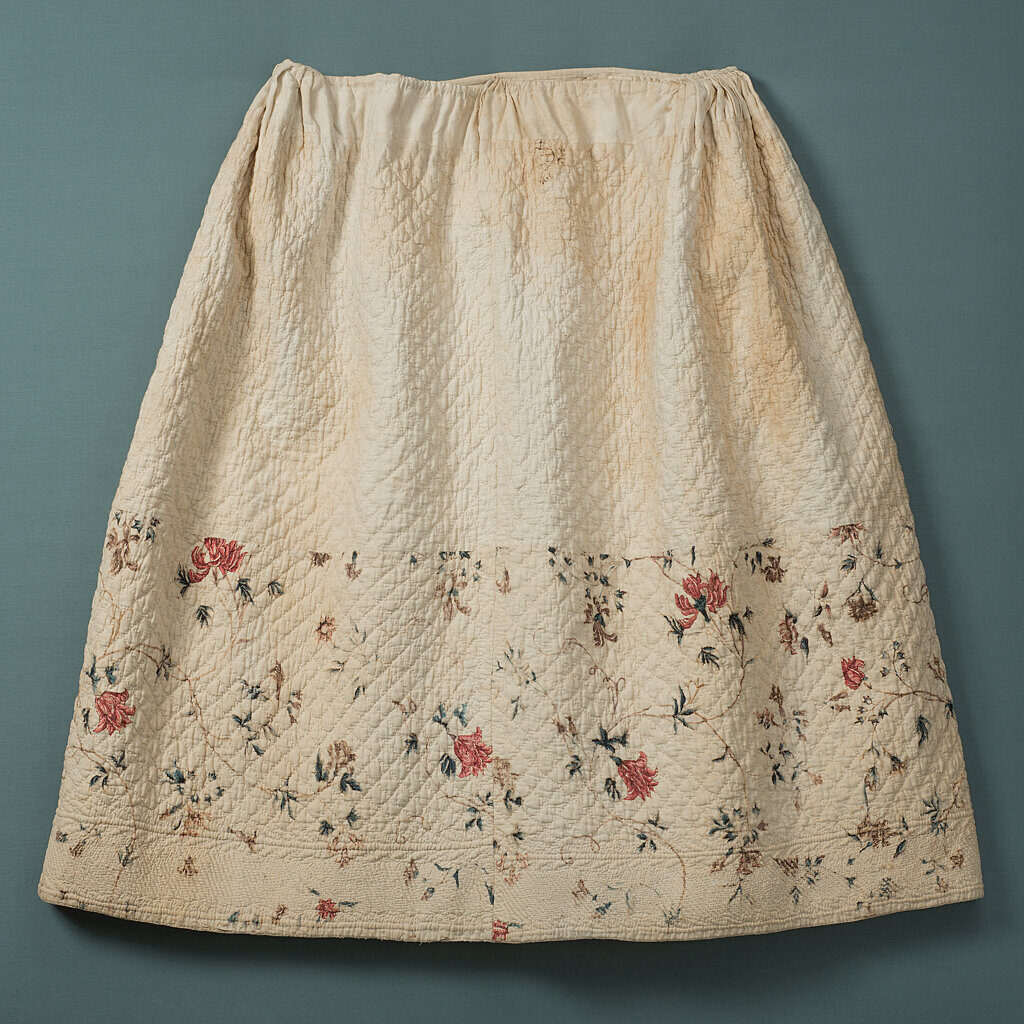
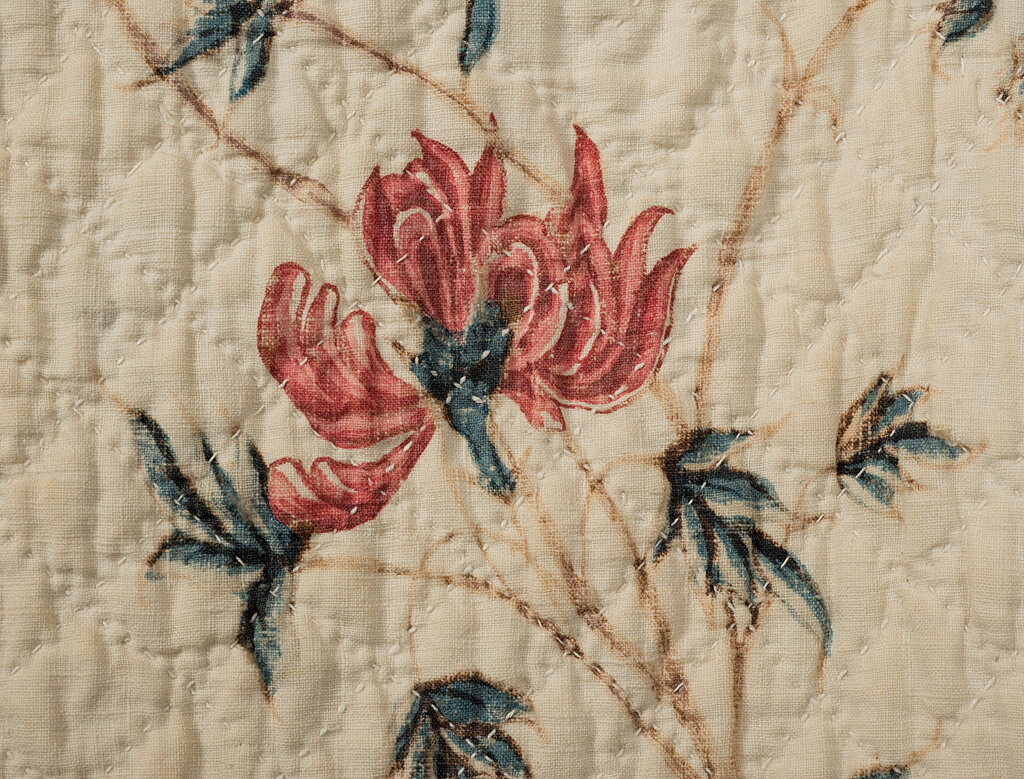
Seventeenth-century Indian painted-and-printed cottons captured the interests and imaginations of England and Europe. The finest examples of chintz trumpeted the skill of Indian artisans, especially those from the southeast Coromandel Coast, who used a combination of mordant- and resist-dyeing techniques on mostly plain-woven cotton fabrics to create detailed and colorfast designs.[4] Enterprising people in the West soon sent designs, or musters, to these Indian craftsmen to copy in the hopes of better appealing to customer tastes back home. Besides colorfast designs, the ability of these Indian artisans to create patterned fabric featuring white, undecorated grounds to set off vibrantly hued motifs only increased their vogue in the West (Fig.7a, b).

Fig. 7a, b. Petticoat and detail, painted and printed, mordant- and resist-dyed, plain weave quilted cotton, India and England, 1750-1800. F.654.

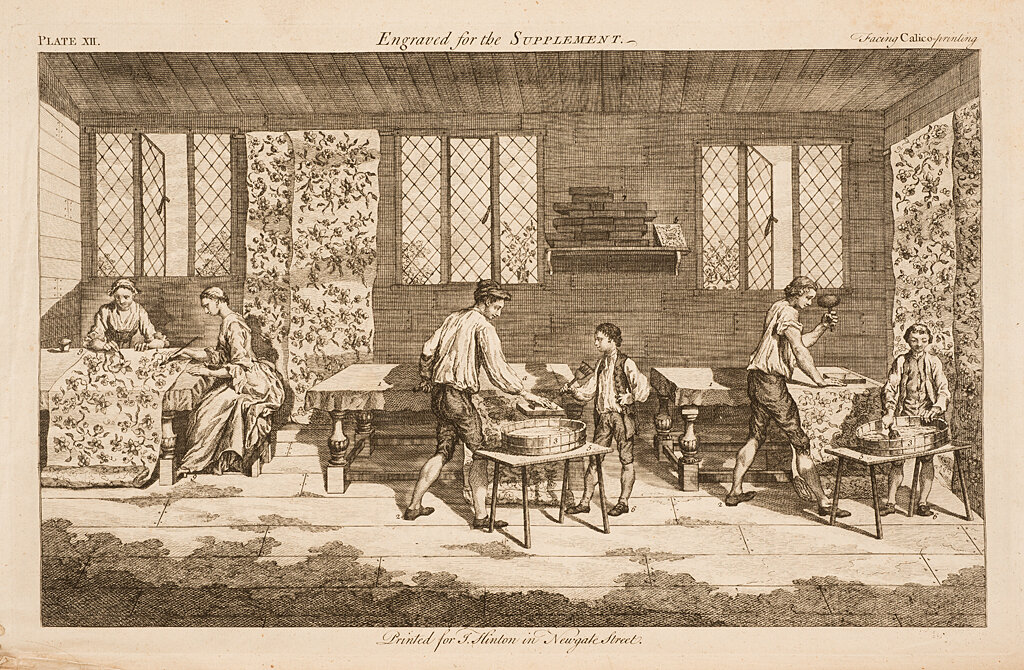
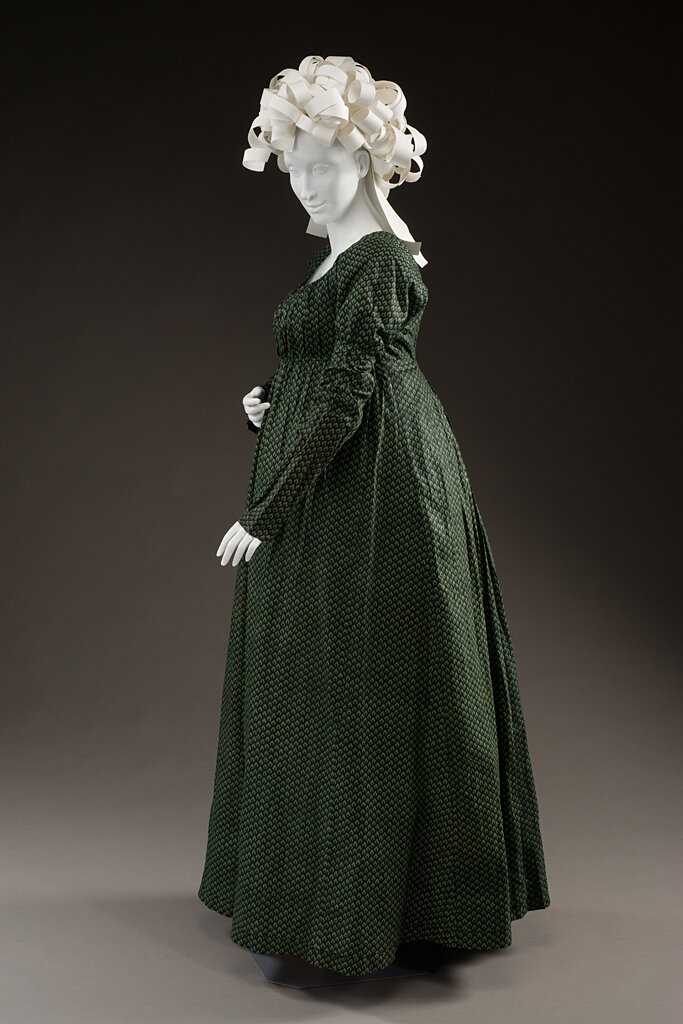
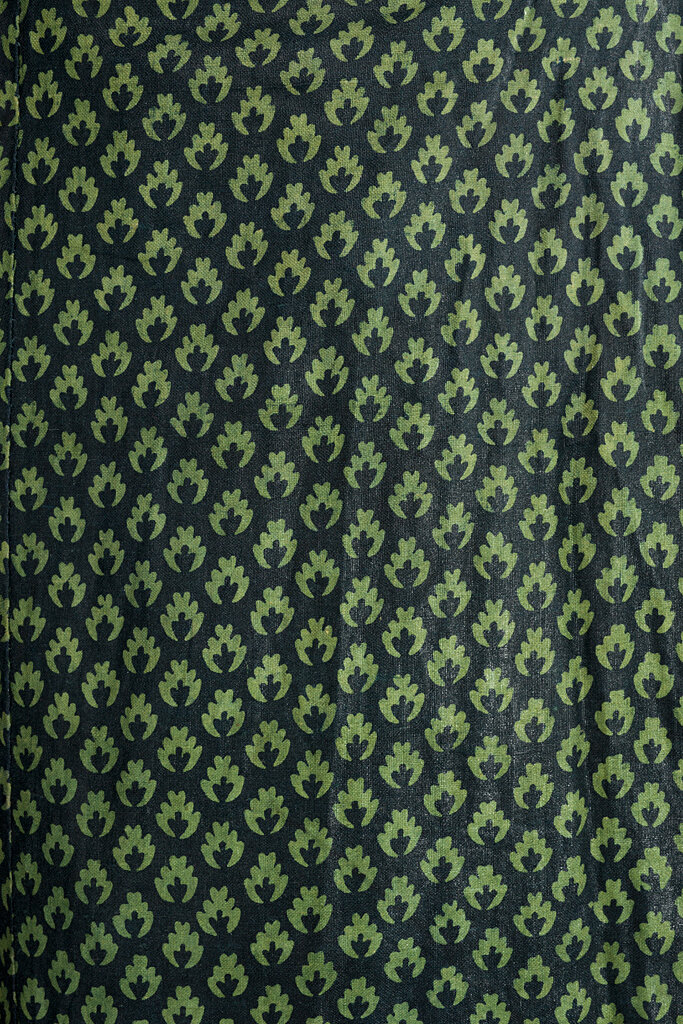
By the early eighteenth century, long frustrated by their lack of success replicating the colorfast techniques of India, English and European printers and dyers began experimenting in earnest (Fig. 8). These efforts eventually yielded more generalized, less detailed designs using printing techniques. Writing about his late eighteenth-century childhood during the 1840s, Deerfield, Massachusetts, historian Epaphras Hoyt (1765-1850) remembered women in the 1770s wearing “calicos [of] stamped linen” when more popular printed cottons imported from English merchants became unavailable during the American Revolution. Hoyt recalled these homemade versions possessed motifs created by using wooden stamps that decorated the linen with motifs that “might please the eye.” But the colors achieved, using inferior, natural dyes that were locally available, did not last.[5] By the end of the eighteenth century, however, these experiments paid off. Woodblocks, engraved copper plates, and cylinders were all employed to produce stylized floral designs, which also became smaller as the century ended (Fig.9a, b).

Fig. 8 “Calico Printing,” from John Barrow, A Supplement to the New and Universal Dictionary of Arts and Sciences. London, 1754.
Fig. 9a, b. Gown and detail, English and American, c. 1800. Blue and green, block-printed, plain-weave, glazed cotton; undyed, plain-weave linen lining. Hall and Kate Peterson Fund for Paintings, Prints, Drawings, and Photographs, 2019.6.

In addition to their pleasing, decorative effects, the inclusion of two-dimensional flowers on textiles worn for dress on three-dimensional bodies held deeper meanings in Western society. Flowers could spark conversation and interest. New or exotic flora could signal knowledge of the latest trends in horticulture or an awareness of different cultures.[6] In this way, these fabrics served as portable libraries or communicators of a person’s knowledge, as well as reflect their access to, and knowledge of, the latest fashions.

[1] Vanessa Remington, Painting Paradise: The Art of the Garden (London: Royal Collection Trust, 2015).

[2] Lesley Ellis Miller, “Education and the Silk Designer: A Model for Success?,” in Mary Schoeser and Christine Boydell, eds., Disentangling Textiles: Techniques for the Study of Designed Objects (London: Middlesex University Press, 2002), 185-194. Moira Thunder, “Improving Design for Woven Silk: The Contribution of William Shipley’s School and the Society of Arts,” Journal of Design History 17 No. 1 (2004): 5-27.

[3] Lesley Ellis Miller, “Jean Revel: Silk Designer, Fine Artist, or Entrepreneur?,” Journal of Design History 8 No. 2 (1995): 79-96.

[4] Rosemary Crill, Chintz: Indian Textiles for the West (London: V&A Publishing, 2008).

[5] Epaphras Hoyt, “Dress of Females,” in Recollections of times and things of my early life, with a sketch of recent improvements, and remarks upon the principles of our government, on our parties & our frequent political condition (unpublished manuscript), 25. Historic Deerfield Library. Thanks to Barbara Mathews, Public Historian and Director of Academic Programs at Historic Deerfield, for bringing this to my attention.

[6] Clare Browne, “The Influence of Botanical Sources on early 18th-Century English Silk Design,” in 18th-Century Silks: The Industries of England and Northern Europe (Riggisberg; Abegg-Stiftung, 2000), 25-38.

July 12, 2018 Kaila Temple, Bartels Intern

Chic Cuts: The Abercrombie Fabric Swatchbook

Fig. 1

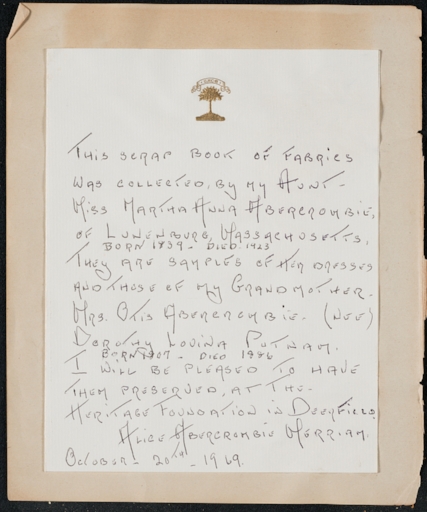
Clothing can often be a vessel for some of our most vivid memories. Garments can recall specific moments and important life events. Like the memories we cherish, saved clothing or its emblems preserves memory through tactile and visual senses. Martha Anna Abercrombie (1839-1923) of Lunenburg, Massachusetts, certainly tapped into this aspect of human nature when she assembled a swatch book of fabrics worn by her and her mother during the late 19th and early 20th centuries (fig. 1).[1] Donated to Historic Deerfield in 1969 by Martha Anna’s niece, Abercrombie’s preserved swatches record important moments ranging from a “first silk dress” to the colorful silk fabrics worn by her and other members of the family attending Harvard “class days.” Present as well are the more every day printed cottons from garments worn throughout her life. Taken as a whole, Abercrombie’s work provides important insight into fashion, memory, and daily life during the late 19th and early 20th centuries.

Swatch books, sometimes known as sewing diaries, are a well-documented way in which women recorded their clothing and the textiles they used.[2] Extant American examples dating from the mid to late nineteenth century, including Abercrombie’s, record clothes made by the women of the household, or in the case of more affluent individuals, by a dressmaker.[3] The recording impulse of these women shows just how valuable fabrics and clothing were, as well as the important role fashion played in their lives. More than just laborious documentation or sentimental records, these swatch books often showcase female artistic expression. Many of the pages are laid out with careful attention to color and texture, and some other sewing books contain sketches of garments[4].

Abercrombie’s work reveals that residents in Lunenburg, located in north-central Massachusetts, had access to many different kinds of textiles. The book contains assembled swatches of fabric used to create garments worn by Martha Anna, as well as those worn by her mother, Mrs. Otis Abercrombie (nee Dorothy Lovina Putnam, 1807-1886). Martha Anna assembled the book between 1890 and 1923, the year of her death. The pasted swatches are spread out among the 29-page booklet, which was assembled in hindsight as a record of past fashions, and not in real time as these fabrics were being purchased. Some pages display notations made in pencil, recording the date and/or use of the corresponding fabrics. The earliest written date for a fabric is 1850.

Of course, as a record largely after-the-fact, some errors may be present in the recording of specific details. But the collection of swatches allows us to study and engage with garments that no longer exist. These swatches give an idea of what fabrics a woman of her economic means was using to make her garments, as well as what textiles were readily available for purchase. This book also provides information on how often new clothes were made, and what sorts of occasions warranted new clothing. While much of the significance of the swatches is personal, they information they collectively yield is invaluable to scholars of material culture, connecting fashion to the larger historical narrative of the period.

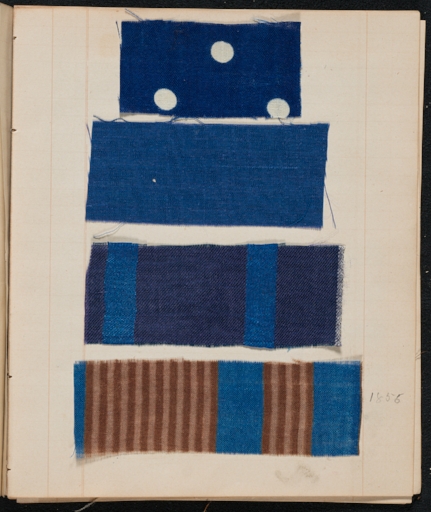
Most directly, the swatchbook chronicles fashionable colors and fabric types. A bright blue color, possibly achieved through synthetic dye, appears multiple times in the swatch book (fig. 2). Synthetic aniline dyes first appeared in the second half of the 1850s; their development allowed for much brighter and vibrantly colored textiles.[5] Early synthetic dyes were especially susceptible to fading; extant garments made from fabrics dyed in these colors (especially blue) usually exhibit muted or splotchy hues from the deterioration of both fabric and dye as a result of cumulative exposure to light and environmental pollution. Because they have been protected in the book, however, the swatches dyed with the synthetic blue retain much of their original color, acting as a valuable visual resource for imagining what these fabrics looked like when new.

Fig. 2

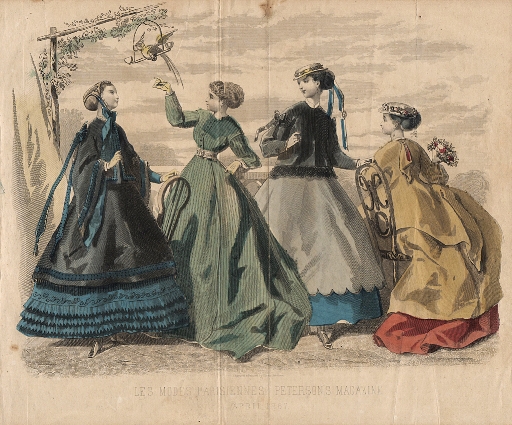
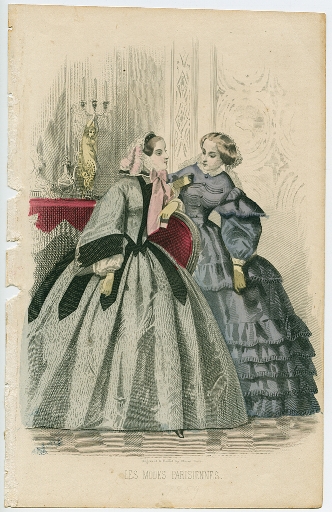
Several extant, colored fashion plates from the 1860s also feature the bright blue color in dresses and accessories (fig. 3). While most fashion plates at the time were hand-colored, the presence of numerous examples with similar shades of blue suggest a popularity for novel, bright aniline dyes in fashionable dress.[6] Such a vibrant silk fabric was used for a “class day” dress, worn by Martha in 1866.

Fig. 3

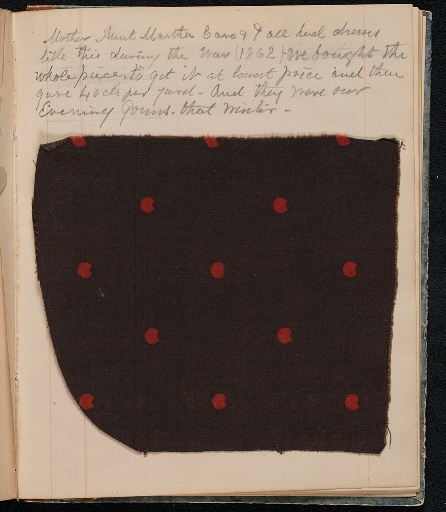
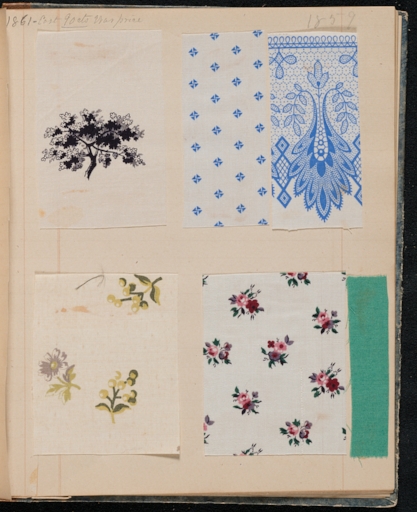
This swatch book also connects its maker to the Civil War. The swatch on page 22 features a woven black cotton (now faded to brown) decorated with red spots, was purchased for “40 cts per yard” (fig. 4). Abercrombie notes the fabric’s employment to make the evening dresses she and the women of her family wore that winter. She also remarks that the whole length of cloth was bought to get the best price, and that several women in her family had dresses made from it “during the war”. The Civil War is mentioned again (dated a year before, 1861) on the next page (fig. 5). Here is affixed a cotton fabric with a printed tree motif, bought at “9cts War Price”. Cotton would have been an unusual choice for an evening gown, with silk being preferred for its smooth texture and luster. This choice of fabric for evening wear, when compared with the recorded silk fabrics used for day dresses in earlier years, demonstrates the impact of the war on the availability of occasion-specific fabric, and highlights the changes in lifestyle and spending that became necessary in wartime, despite being geographically far removed from military action.

Fig. 4
Fig. 5

It is easy to see why Martha highlighted these particular textiles within the book, given the enormous presence of the Civil War in daily life and the emotional and physical scars it left on much of the American population. The notations reveal a strong memory of such a tumultuous time. The Civil War references are, coincidentally, the only two in the book where cost is noted, suggesting the economic impact the war had on her everyday life. The cotton embargo of 1861 and Union blockades of Confederate ports greatly reduced the flow of raw cotton to the manufacturing centers of Britain, raising tensions and the question of British military involvement[7]. Although meager, the two references reflect issues of global trade and manufacturing during times of crisis, and the effects on the lives of everyday people.

Fig. 6
Fig. 7

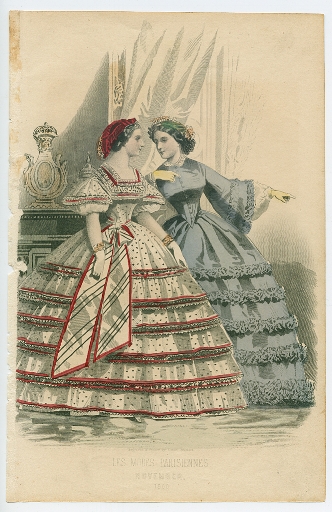
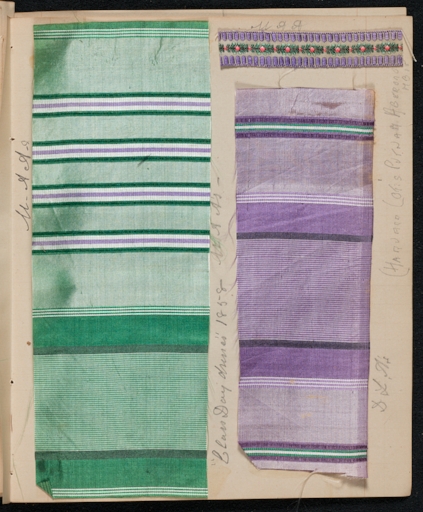
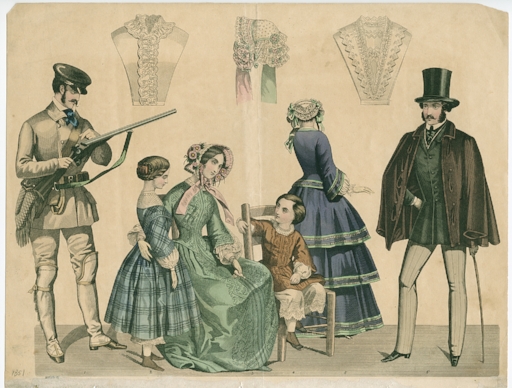
Clearly, Abercrombie cared about fashion. Turning again to fashion plates, we can compare the spotted cotton used for the war time evening dresses with a spotted gown from an 1860 American fashion plate (fig. 6). Similarly, a textile with a crinkled texture, found on several pages of the swatch book, resembles an illustrated textile (possibly moiréd) seen in an 1859 fashion plate (fig. 7). On a page containing fabrics from 1858 “class day” dresses, the compiler included a sample of the purple and white trim used on a green, white, and purple striped silk dress (fig. 8). A fashion plate from 1851 (fig. 9) shows a similar combination of colors, and perhaps a suggestion of how the trim was used on the gown. While there is no way of truly knowing what Martha’s garments actually looked like, the combination of the swatch book and fashion plates suggest an awareness and ability to incorporate stylish dress fabric patterns into her own wardrobe, even if they were not of the most refined textiles.

Fig. 8
Fig. 9

While this swatch book is by no means explicit in its description of clothing and fashion, as well as in its links to larger themes and issues, the subtle details included by the compiler can provide clues as to how her own connection to the events of history was preserved in her memory through her clothes. Through her swatches, we can see hints of the changing fashions, new technology, and the effect of large historical events such as the Civil War. This colorful record of a woman’s wardrobe is a tangible link to the past and a potent reminder of the importance and emotional power clothes held, and continue to hold, in our lives.

[1] Historic Deerfield, Gift of Mrs. Lewis Merriam (Alice Abercrombie Merriam), V.050.

[2] An important, early example is the swatch book and clothing diary of Barbara Johnson, an English woman born in 1738 who painstakingly recorded the yardage, cost and use of the fabric she purchased. See Natalie Rothstein, ed. A Lady of Fashion: Barbara Johnsons Album of Style and Fabrics (London: Thames and Hudson, 1987).

[3] For other American examples, see Susan W. Greene, Wearable Prints, 1760-1860: History, Materials, and Mechanics (Kent, OH: Kent State University Press, 2014), 10; Karen J. Herbaugh, “Needles and Pens: The Sewing Diaries of American Women, 1890-1920,” The Dublin Seminar for New England Folklife Annual Proceedings 1(2006/2007), printed 2009: 95.

[4] Ibid., 98

[5] Greene, “Wearable Prints”, 200-201.

[6] Joan L. Severa, Dressed for the Photographer: Ordinary Americans and Fashion, 1840-1900 (Kent, OH: Kent State Univ. Press, 1995), 196.

[7] Sven Beckert. “Emancipation and Empire: Reconstructing the Worldwide Web of Cotton Production in the Age of the American Civil War.” The American Historical Review 109, no. 5 (2004): 1405-438. 1410