By Phillippa Pitts
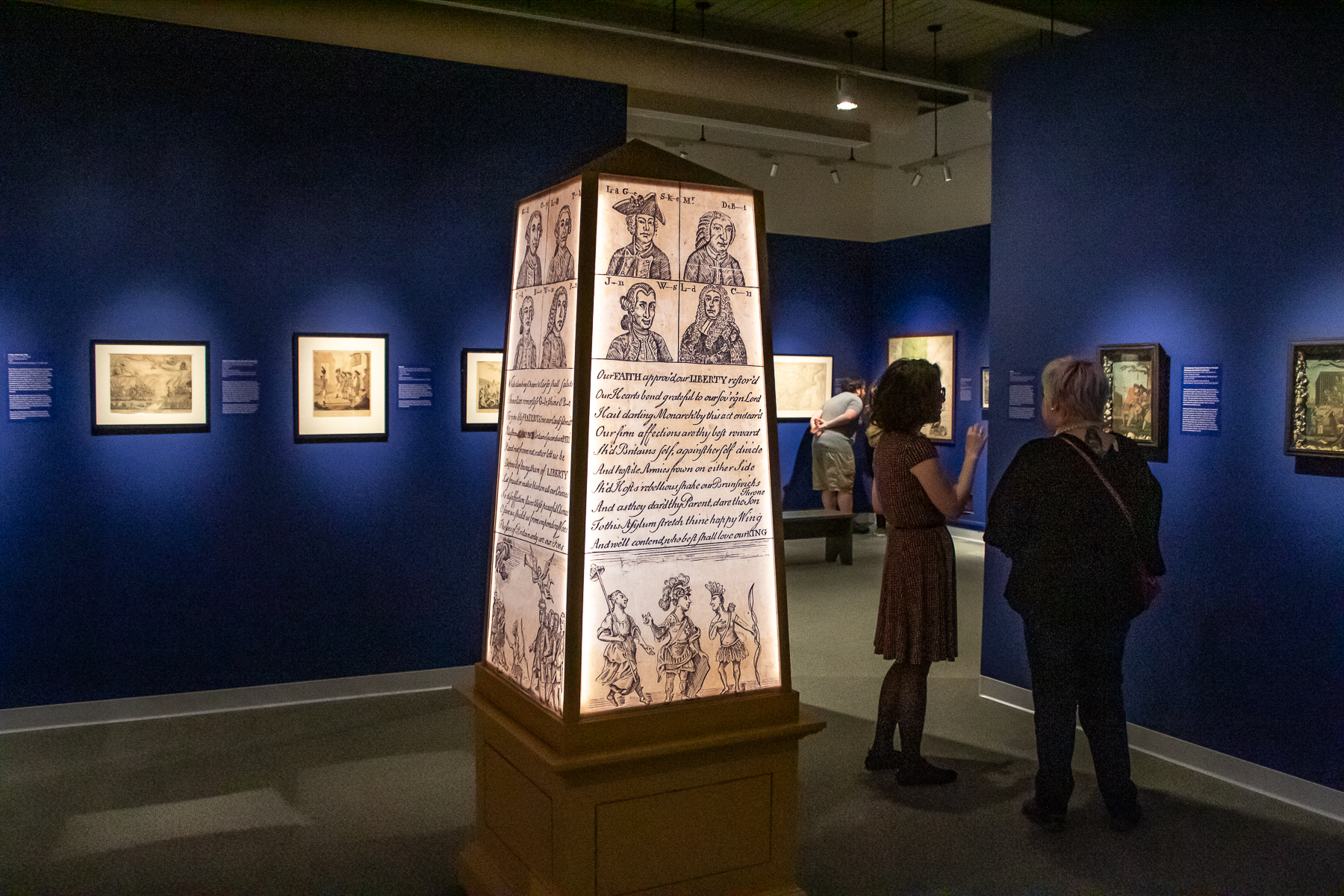
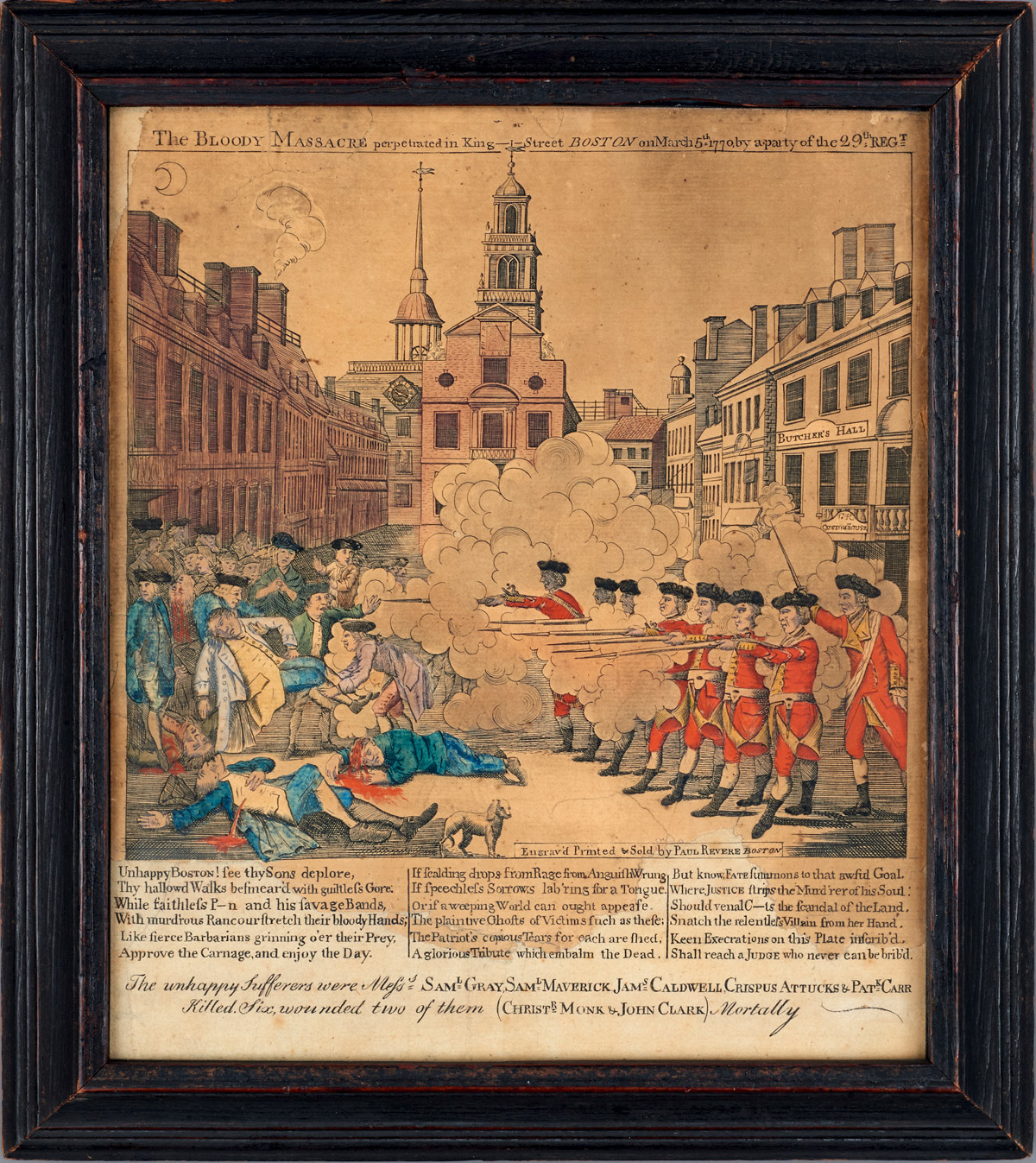
In museums today, we usually encounter eighteenth-century prints neatly framed, hung on the walls of quiet galleries, with low light to protect the sensitive papers and pigments. Such care preserves these works of art for future generations. But it also distorts our perception of early American print culture. We know that only a small fraction of the thousands of prints produced during the American Revolution survive. Included among these losses are the extraordinary ephemeral objects produced for protests and public celebrations.
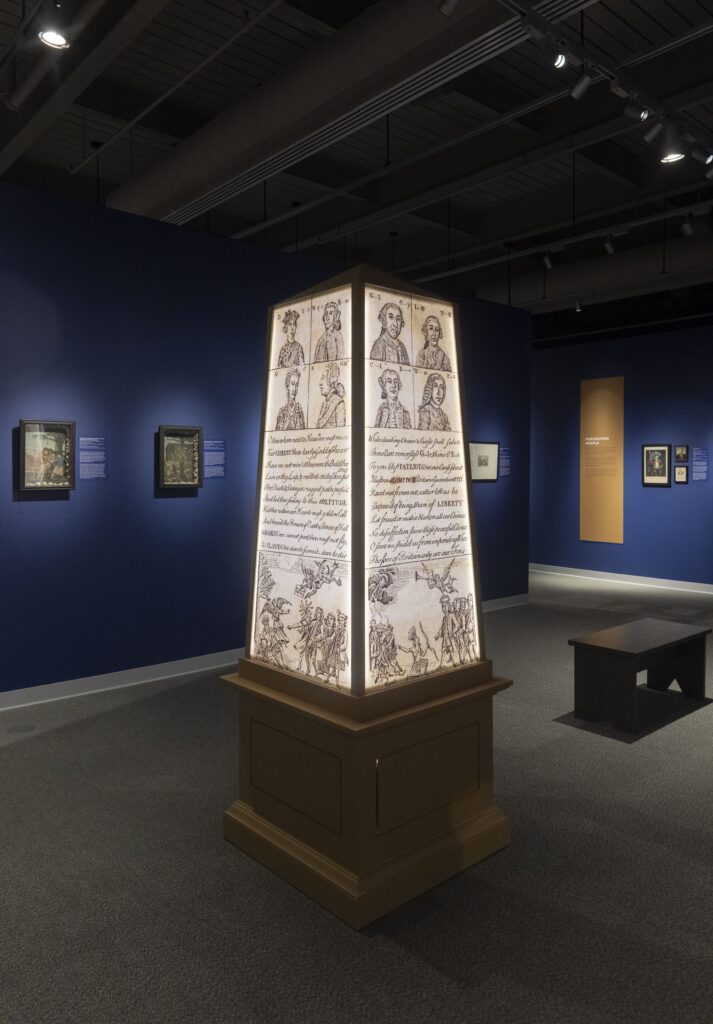
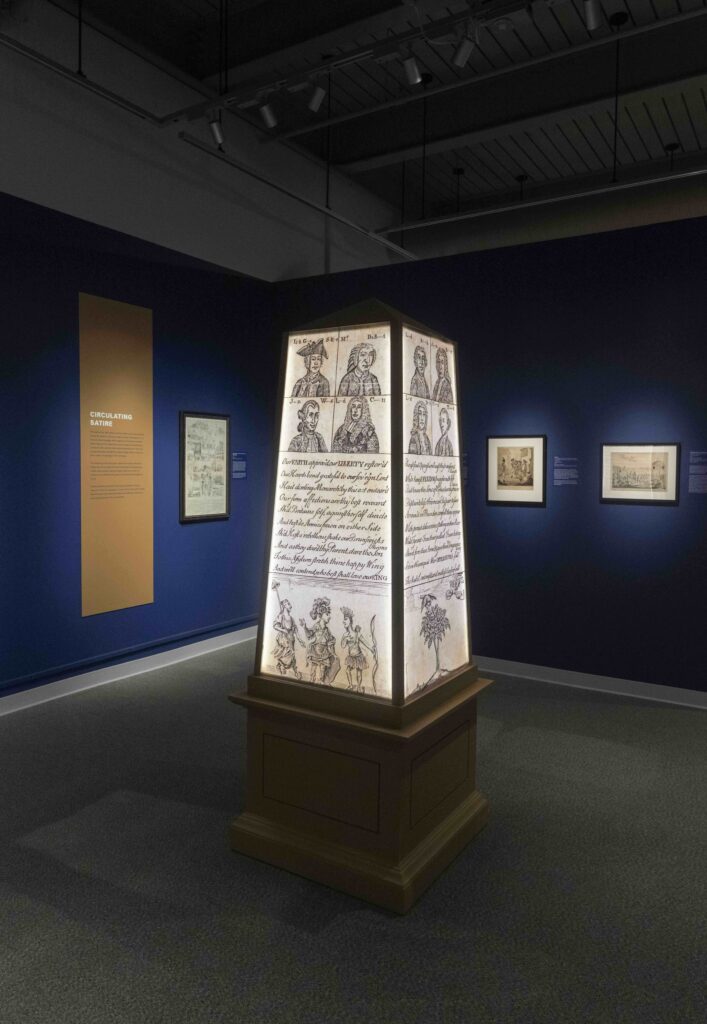
To bring this lost aspect of print culture into our new exhibition, Picturing the Revolution, we created a reproduction of one such spectacle: the theatrical obelisk created in 1766 by the Sons of Liberty to celebrate the repeal of the deeply unpopular Stamp Act. According to the description published in a local paper, it was a “magnificent Pyramid, illuminated with 280 lamps.” [1] Its sides were decorated with sixteen portraits, an extensive poem, and four illustrated scenes, all celebrating the triumph of Liberty over oppression and tyranny. This paper-and-wood structure was then crowned by a horizontal spinning wheel from which 16 fireworks were launched as the grand finale of a city-wide day of rejoicing, animated by music, tolling church bells, cannon salutes and a “Pipe of Madeira Wine” provided by John Hancock. Surprisingly, the original obelisk survived not only its own pyrotechnics, but hours of what the Massachusetts Gazette described as an “endless” display in which “the Air was fill’d with Rockets—the Ground with Bee hives and Serpents—and the two Stages with Wheels of Fireworks of various sorts.” [2] Unfortunately, the structure caught fire (or was intentionally set alight) in the early hours of the following morning. [3]
Although the original obelisk was short-lived, the details of its design survive in an engraving by Paul Revere (who almost certainly participated in its creation). The print was likely intended for sale as a souvenir. For us, it served as the basis for our reconstruction. The American Antiquarian Society generously provided us with high-resolution photography of their copy of the engraving, and New York Historical shared preliminary plans from their recreation of the obelisk in 2020. Our preparator, Chris Nelson, brought the project to life, working veritable magic to make our obelisk glow in the darkened gallery.
This illumination is more than just aesthetically pleasing; it’s a challenge to our preconceptions about paper. The obelisk’s makers did not simply paste their designs onto a solid structure. They stretched the paper across a hollow scaffold, lighting it from within so that the obelisk would shine dramatically in the dark of Boston Common. They even rubbed oil into the paper to increase its transparency. Five years later, Revere used the same approach to turn the front of his house into an illuminated stage to memorialize the first anniversary of the Boston Massacre. He covered each of his front windows with a different illustration, rendered on oiled paper and lit with a candle on the interior sill. Unfortunately, this dramatic spectacle survives only in the form of a lengthy description in another local paper. [4]
Across the archive, we find tantalizing glimpses of the sheer variety of inventive theatrical objects created (and destroyed) in early American parades and protests. In just this exhibition, you will also find images of giant papier-mâché heads fabricated by protesting school children, as well as effigies (or life-size dolls) of local customs enforcers.
By bringing together a broad range of materials—from maps to broadsides, carved powder horns to shellwork shadowboxes— Picturing the Revolution showcases images and makers that rarely find their way into our history books. With the inclusion of the obelisk, we are even able to include materials that, although never meant to survive, nonetheless played a vital role in setting the stage for the War for Independence.
Phillippa Pitts is Historic Deerfield’s Luce-Americana Curatorial Fellow for American Art.
[1] Massachusetts Gazette and Boston News-Letter, Boston, no. 3268 (May 22, 1766): 2.
[2] Ibid.
[3] For the most complete analysis of the obelisk, see Nancy Siegel, “The Work of Art and the Art of Work: Prints and Ephemera by Paul Revere,” in Beyond Midnight: Paul Revere, ed. Lauren Hewes and Nan Wolverton (Worcester, MA: American Antiquarian Society, 2019), 43–49.
[4] The Boston-Gazette and Country Journal, 11 March 1771.
Picturing the Revolution is available to view at the Flynt Center through January 3, 2027. Read more about the exhibition here.
Picturing the Revolution was made possible in part by a major grant from the National Endowment for the Humanities: Democracy demands wisdom. It was also generously supported by the Massachusetts Office of Travel and Tourism.