Open 9:30 a.m. – 4:30 p.m. Wednesdays – Sundays, & Monday Holidays.

PLAY TICKETS & INFO / EVENTS / VISITOR INFO

July 1, 2026 Phillippa Pitts

Recreating Revere’s Obelisk

By Phillippa Pitts

In museums today, we usually encounter eighteenth-century prints neatly framed, hung on the walls of quiet galleries, with low light to protect the sensitive papers and pigments. Such care preserves these works of art for future generations. But it also distorts our perception of early American print culture. We know that only a small fraction of the thousands of prints produced during the American Revolution survive. Included among these losses are the extraordinary ephemeral objects produced for protests and public celebrations.

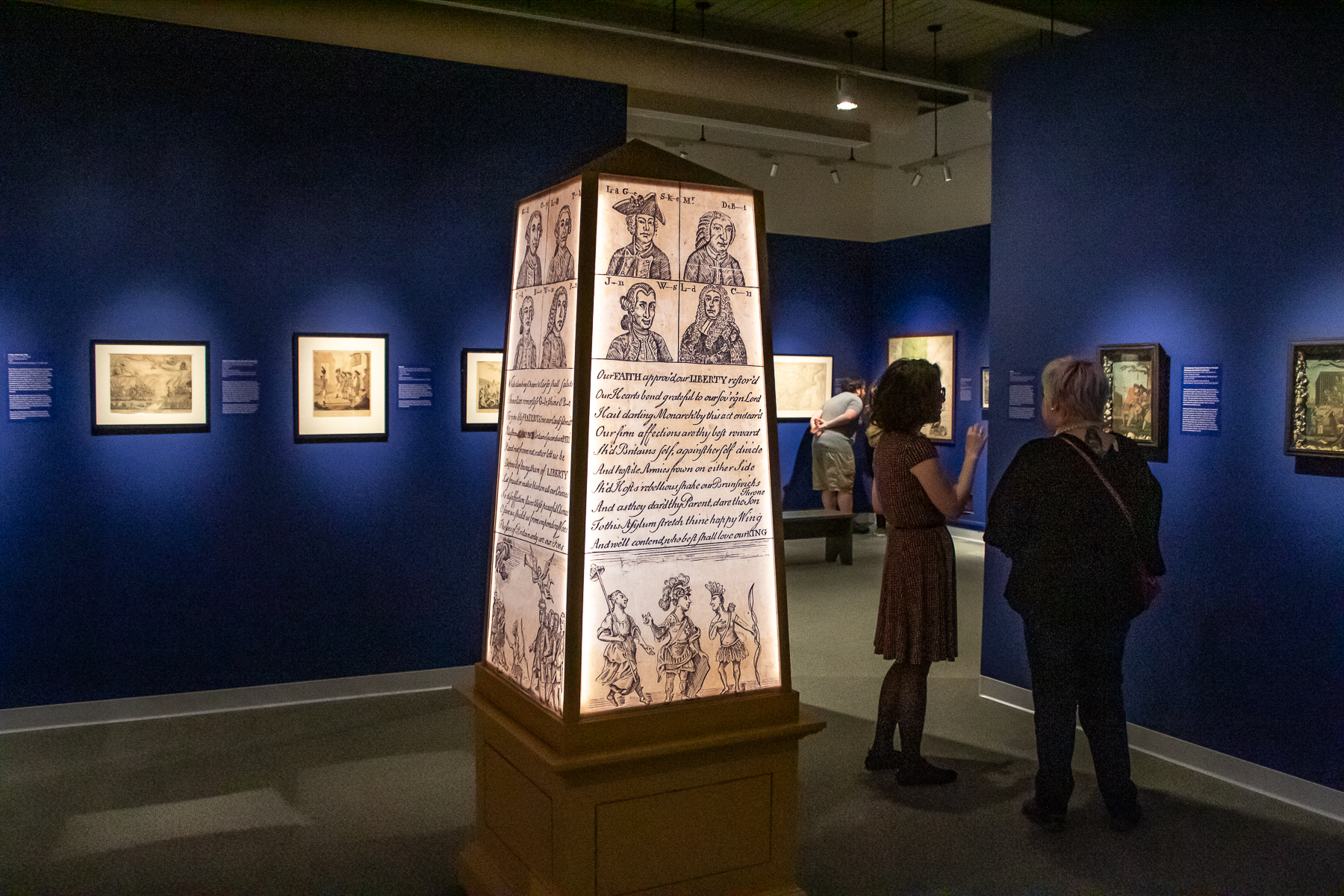
To bring this lost aspect of print culture into our new exhibition, Picturing the Revolution, we created a reproduction of one such spectacle: the theatrical obelisk created in 1766 by the Sons of Liberty to celebrate the repeal of the deeply unpopular Stamp Act. According to the description published in a local paper, it was a “magnificent Pyramid, illuminated with 280 lamps.” [1] Its sides were decorated with sixteen portraits, an extensive poem, and four illustrated scenes, all celebrating the triumph of Liberty over oppression and tyranny. This paper-and-wood structure was then crowned by a horizontal spinning wheel from which 16 fireworks were launched as the grand finale of a city-wide day of rejoicing, animated by music, tolling church bells, cannon salutes and a “Pipe of Madeira Wine” provided by John Hancock. Surprisingly, the original obelisk survived not only its own pyrotechnics, but hours of what the Massachusetts Gazette described as an “endless” display in which “the Air was fill’d with Rockets—the Ground with Bee hives and Serpents—and the two Stages with Wheels of Fireworks of various sorts.” [2] Unfortunately, the structure caught fire (or was intentionally set alight) in the early hours of the following morning. [3]

Although the original obelisk was short-lived, the details of its design survive in an engraving by Paul Revere (who almost certainly participated in its creation). The print was likely intended for sale as a souvenir. For us, it served as the basis for our reconstruction. The American Antiquarian Society generously provided us with high-resolution photography of their copy of the engraving, and New York Historical shared preliminary plans from their recreation of the obelisk in 2020. Our preparator, Chris Nelson, brought the project to life, working veritable magic to make our obelisk glow in the darkened gallery.

This illumination is more than just aesthetically pleasing; it’s a challenge to our preconceptions about paper. The obelisk’s makers did not simply paste their designs onto a solid structure. They stretched the paper across a hollow scaffold, lighting it from within so that the obelisk would shine dramatically in the dark of Boston Common. They even rubbed oil into the paper to increase its transparency. Five years later, Revere used the same approach to turn the front of his house into an illuminated stage to memorialize the first anniversary of the Boston Massacre. He covered each of his front windows with a different illustration, rendered on oiled paper and lit with a candle on the interior sill. Unfortunately, this dramatic spectacle survives only in the form of a lengthy description in another local paper. [4]

Across the archive, we find tantalizing glimpses of the sheer variety of inventive theatrical objects created (and destroyed) in early American parades and protests. In just this exhibition, you will also find images of giant papier-mâché heads fabricated by protesting school children, as well as effigies (or life-size dolls) of local customs enforcers.

By bringing together a broad range of materials—from maps to broadsides, carved powder horns to shellwork shadowboxes— Picturing the Revolution showcases images and makers that rarely find their way into our history books. With the inclusion of the obelisk, we are even able to include materials that, although never meant to survive, nonetheless played a vital role in setting the stage for the War for Independence.

Phillippa Pitts is Historic Deerfield’s Luce-Americana Curatorial Fellow for American Art.

[1] Massachusetts Gazette and Boston News-Letter, Boston, no. 3268 (May 22, 1766): 2.

[2] Ibid.

[3] For the most complete analysis of the obelisk, see Nancy Siegel, “The Work of Art and the Art of Work: Prints and Ephemera by Paul Revere,” in Beyond Midnight: Paul Revere, ed. Lauren Hewes and Nan Wolverton (Worcester, MA: American Antiquarian Society, 2019), 43–49.

[4] The Boston-Gazette and Country Journal, 11 March 1771.


Picturing the Revolution is available to view at the Flynt Center through January 3, 2027. Read more about the exhibition here.

Picturing the Revolution was made possible in part by a major grant from the National Endowment for the Humanities: Democracy demands wisdom. It was also generously supported by the Massachusetts Office of Travel and Tourism.

June 23, 2026 Lauren D. Whitley

A Tale of Two Stockings

By Lauren D. Whitley

Simple and hand-knitting stocking (left) and fine silk stocking (right).
Detail of silk stocking.

Two stockings sit side by side in a case. One is simple and hand-knitted, the other is one of a pair made with fine silk. In production and quality, they tell us two very different stories of knitting—and style—in the 18th century.

Knitting was so intrinsic to the daily life of women in the American colonies that references are scant in journals, diaries, and letters. The woman who knitted the lone stocking on the left of Figure 1 250 years ago remains anonymous. She probably hand-spun her linen yarn. She did not use the finest of steel knitting needles, or “pins” as they were called, which could be as small as one millimeter in diameter. Still, she produced a smooth stocking, working into the heel a squared box typical of the period. She even added a bit of decorative ribbing at the top.

This was a stocking made for everyday wear. At some time during the years that ensued, the stocking lost its mate, as often happens. Yet, it remains a testimony to this ubiquitous and continuous activity plied by women in New England. As part of their daily chores, women knitted linen, wool, cotton, and silk in plain, ribbed, and fancy styles with purled motifs for Sunday best. And when the stockings wore thin, women darned and “footed” them, replacing the heels to make them new again.

Newport Mercury, 13 February 1769.

In the years just prior to and during the Revolutionary War, knitting acquired political overtones. The adoption of non-importation and non-consumption strategies by colonists in response to British tariffs effectively conscripted women to perform much of the labor of home production. “Knitting for liberty” became a call to duty as women gathered in highly publicized “bees” to spin fibers not only for weaving cloth, but also for knitting. In February of 1769, seven “Ladies of Fashion” in Newport met to support “the Cause of Liberty” by joining in “the laudable Business of KNITTING.”

Knitting was a task not just for women of middling and working classes, but was also taken up by patriotic, well-to-do women. Sarah Morris Mifflin, a Philadelphia Quaker married to Major General Thomas Mifflin, wrote to a friend in Boston, “I have learnt to knit, and am now making stockings of American wool for my servants and this way do I throw my mite to the public good.” [i]

Harsh winter conditions and continuous campaigns during the war took a toll on soldiers’ clothing. Stockings were especially vital as without them soldiers were vulnerable to frostbite. During the winter at Valley Forge—the lowest ebb of the war—George Washington relayed to the Continental Congress the crisis of clothing among his soldiers, many of whom he called “almost naked.” Women in the colonies worked hard to alleviate shortages by spinning wool and linen and knitting as many stockings as possible for their husbands, brothers, and sons. Some women responded by unraveling old stockings to get enough fibers to re-spin and knit new socks and gloves. A few brave women rode to the front lines to deliver shirts, breeches, and woolen stockings.

Sarah and her husband, Thomas Mifflin, were famously painted in 1773 by John Singleton Copley, the most celebrated painter in the American Colonies at the time. The couple is seated at a table. Sarah is depicted weaving a decorative fringe on a portable tape loom which may symbolize her support for the patriot cause and its boycott of English goods. John Singleton Copley (1738–1815) Portrait of Mr. and Mrs. Thomas Mifflin (Sarah Morris), 1773, Oil on ticking, Philadelphia Museum of Art, EW1999-45-1.

Harsh winter conditions and continuous campaigns during the war took a toll on soldiers’ clothing. Stockings were especially vital as without them soldiers were vulnerable to frostbite. During the winter at Valley Forge—the lowest ebb of the war—George Washington relayed to the Continental Congress the crisis of clothing among his soldiers, many of whom he called “almost naked.” Women in the colonies worked hard to alleviate shortages by spinning wool and linen and knitting as many stockings as possible for their husbands, brothers, and sons. Some women responded by unraveling old stockings to get enough fibers to re-spin and knit new socks and gloves. A few brave women rode to the front lines to deliver shirts, breeches, and woolen stockings.

While residing at Valley Forge Headquarters, Mary Washington was frequently seen with needles, hand-knitting wool socks for soldiers. While her husband labored to provision his soldiers with warm wool stockings, he was also known to have ordered his own from London hosiers. Numerous merchant advertisements include references to imported stockings, or “hose.”

The Boston Chronicle, 27 November 1769.
Reproduced from The Book of English Trades and Library of the Useful Arts, London: F.C. & J. Rivington, 1821.

Imported stockings were produced on mechanized knitting looms, or “stocking frames,” an invention credited to William Lee of Cambridge, England in 1589. Improvements to the device in the 18th century increased not only the speed with which stockings were knitted, but also the fineness, especially when employing silk threads.

The technical achievements of the British stocking frame industry are illustrated in the elegant silk stockings that sit to the right of the homespun sock in Figure 1. The stitches are fine gauge and feature fancy patterning, called “clocking,” at the ankles.

Interestingly, these stockings were never worn. They were taken from the British merchant ship, Hannah, when it was captured south of Long Island in 1781 by the American privateer, Minerva, under the command of American Captain Dudley Saltonstall. The Hannah had been heading to British-controlled New York with a cargo of West Indian goods and gunpowder, valued at 80,000 pounds sterling. It became the largest maritime prize taken during the entire Revolutionary War. Particularly galling, the Hannah was also transporting personal supplies for the British officers stationed in New York City; among them was this pair of silk stockings. The loss of the Hannah spurred the British to retaliate at the Battle of Groton Heights and New London, Connecticut was almost leveled under the attacks of the newly traitorous General Benedict Arnold.

Lauren D. Whitley is the Curator of Historic Textiles and Clothing at Historic Deerfield.

[i] As quoted in Anne L. Macdonald, No Idle Hands: The Social History of American Knitting (New York: Ballentine Books, 1988), 33.

May 18, 2026 Claire Carlson, Patrick Gabridge, Talya Kingston

Bringing the Revolution to Life with Plays in Place 

A conversation with Historic Deerfield’s Director of Museum Education/Director of Archaeology Claire Carlson, Producing Artistic Director Patrick Gabridge, and Producer and Playwright Talya Kingston of Plays in Place about A Stake in the Ground: 1774, commissioned by Historic Deerfield. To be published in the Summer 2026 issue of the Historic Deerfield Magazine.


Claire: Can you tell our readers about Plays in Place? What is unique about the plays you write and produce?

Talya: Plays in Place is a theatre company that produces original site-specific theatre in collaboration with museums and historic sites. As playwrights, rather than starting with a story from our own imaginations, we begin our conversation with experts at the sites who tell us stories, show us their spaces, and give us access to primary source materials.

Patrick: Our work is always grounded in place. So we’re trying to understand the space where we’re performing and how our characters existed in it. The project partnerships usually require a time span of multiple years from inception to production, so everyone is making a big commitment.

Claire: What is your process once you have a site to work with? What inspires and challenges you? How do you develop the specific themes and structures of your plays?

Patrick: Every site has a story, sometimes more than one, and every place is different. We are presented with the puzzle of what is the best story to develop into a play, and how do we make it work in a way that is theatrically engaging for audiences while taking advantage of the particular elements of that specific place. Solving those challenges is always exciting for us.

We create a lot of plays that center around slavery and abolition in New England, as well as plays in the Revolutionary War period, and also plays dealing with women’s history and the fight for women’s suffrage. So we have a strong interest in exploring issues of race and gender. We are always trying to develop characters in ways that highlight their full humanity, their complexity. We try to “unflatten” historical figures and moments.

Claire: Can you describe what “in place” means to you and your company? How does the setting guide you as you write the plays and bring the characters to life?

Patrick: We really are trying to find ways to use the site, almost as an additional character. Our mantra as playwrights in writing site-specific plays is “Don’t fight the site.” Use the place. We don’t build sets; we don’t add banks of lights. Our main design elements are costumes and sound. Even if the site isn’t exactly as it was in the era of the story we’re telling, we still try to use it as it is at this very moment.

This doesn’t mean that every show needs to operate in a completely realistic style. But it does require us to be thoughtful about how time and place operate in our plays. Because our work is always a commission, we’re always building from the ground up, so the script and its relationship to the physical space is not “generic,” not just written to be done on any stage, anywhere. Our work is specifically tailored to where we’re at, and we use the inherent meaning that the space and its history brings.

Claire: How do you approach interpreting hard topics in your plays such as votes for women or the history of slavery in New England?

Patrick: The main thing is that we’re not looking at the “issues” first, we’re looking at the people. What can we find out about them through research, which is often limited because their records might not have been preserved? How do we fill the gap if they might not have had the time or resources to create documents that recorded their thoughts? We can learn details about them – births, deaths, baptisms – that help paint a portrait of them as people with full lives. We have to use the historical record and also our imaginations. A lot of time we find things that historians have overlooked, little tidbits, because we’re asking different questions, we’re looking with a different lens. We need to understand everything we can about the periods we’re writing about, talk to lots of historians, read books, examine the archives, but then go back to what we as playwrights know about how people behave in relationship to each other.

Claire: How do you balance your vision with feedback from the host sites, directors, and actors?

Talya: The collaboration between writers/producers, artists (actors, designers and directors) and the site historians and stakeholders continues at all stages of the play’s development. We first present a proposal for a play (or series of plays) and solicit feedback (sometimes even going back to the drawing board). After we write a solid first draft we hire actors for an internal reading of the script and conduct a post-show discussion wherein we discuss any plot holes, historical inconsistencies or character problems. This feedback helps us to come up with a more solid script draft to take into production.

As playwrights we tend to prioritize historical or contextual feedback over artistic critique from the historical experts. It is helpful to bring a director in early in the process to help the writers to see how their writing can be actualized given the confines of performing in a non-traditional space (for example, plays that are performed outside cannot use blackouts for scene changes!) Actors are very helpful in letting us know if the language is too convoluted or the relationships between characters too hard to understand.

Through it all, the playwrights need to have a strong grasp of the story they are telling in order to incorporate feedback without flattening the dramatic impact.

Claire: What can audiences expect at the plays you are doing for Historic Deerfield?

Talya: At Historic Deerfield we were drawn to the backdrop of the street, and how, in the lead up to the Revolution, neighbors had very different perspectives on what the future of the country should look like. In this hot political climate, the neighbors were also intertwined personally with love affairs, rivalries, and feuds. Audiences can expect these characters to come to life in a way that will leave them with questions and a new appreciation for the history of the town as it headed towards Revolution.

Patrick: The key thing is that this is a lively experience, it’s not a lecture or history lesson. It’s a play that tells an interesting story about people we hope you will care about. Our goal is that people see our show and come away wanting to learn more because now this place and these people matter to them.


A Stake in the Ground: 1774

Staged at Historic Deerfield, A Stake in the Ground: 1774 is a series of three site-specific plays, set in Deerfield, on the eve of the American Revolution. Get your tickets here.

In the summer of 1774, seeds of revolution began to germinate in Deerfield when a Liberty Pole is brought to town. The characters in three new one-act plays explore the political division, tangled family relations, and the complexities of enslavement from all sides. Join us this summer to experience this vibrant, immersive examination of the historical split that will define America.

Produced by Plays in Place, written by Talya Kinston, Valyn Lyric Turner, and Patrick Gabridge, and directed by Brianna Sloane, A Stake in the Ground: 1774 will be performed outdoors at the locations near where the characters lived in the past, including outside the Ashley House, the Allen House, and the Stebbins House.

Each performance includes all three plays and will end with a post-show conversation. Shows take place Fridays (6:30–8:30 p.m.), Saturdays (6:30–8:30 p.m.), and Sundays (2:30–4:30 p.m.), July 10–August 16.

Note: All shows (except for the weekend of July 31, August 1 and 2 held inside the Deerfield Community Center) will be held outside and the audiences will be walking to each location.

Please visit historic-deerfield.org/events/a-stake-in-the-ground-1774 for more information and to purchase tickets.
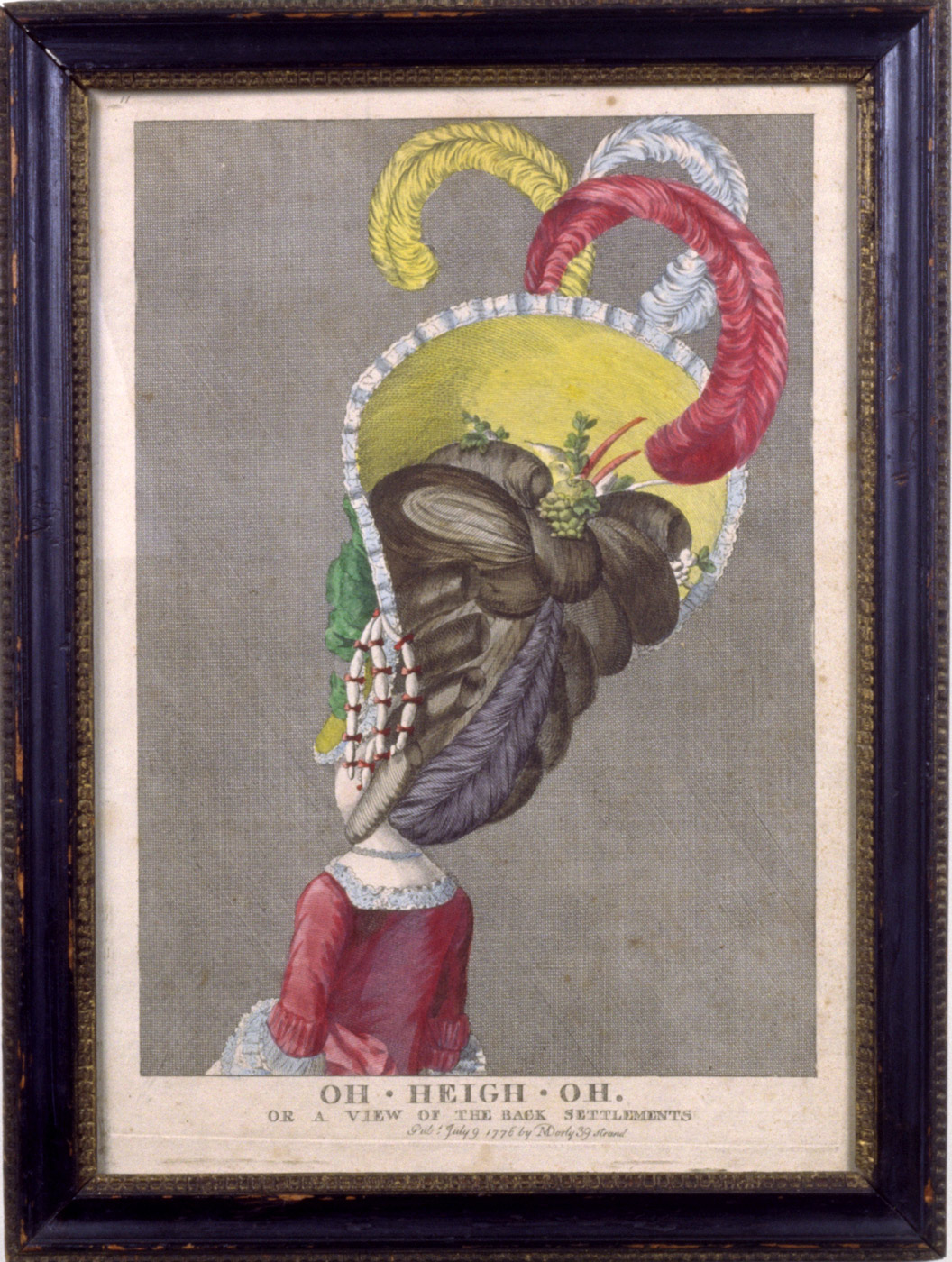
Dressing the Revolution: Fashion and Politics 1760–1789

Matthew and Mary Darly (English) Oh Heigh Oh, Or a View of the Back Settlements. England, London, 1776. Engraving on laid paper with hand-coloring. Gift of Henry N. Flynt and Helen Geier Flynt, HD 56.029.

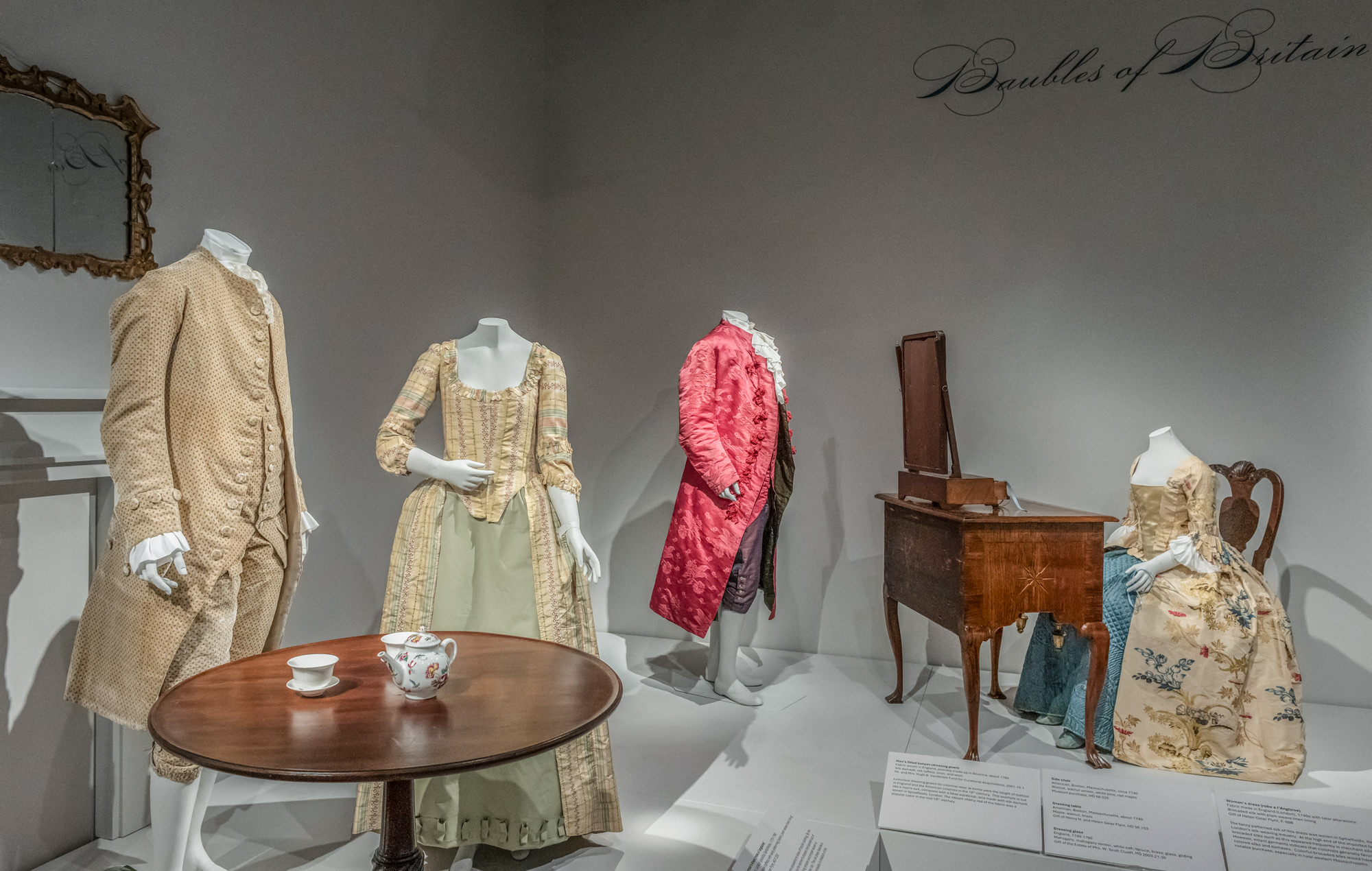
The exhibition includes more than 20 garments, accessories, textiles, and prints that illuminate the complex role of clothing at the time of the American Revolution. By posing new questions about fashion’s relationship with class, race, and gender, Dressing the Revolution: Fashion and Politics 1760–1789 places clothing at the center of the political debates, shedding light on dress as a powerful tool that communicated not just status and identity, but political affinities during this volatile period.

The exhibition begins with a look at the consumer revolution of the mid-18th century when an abundance of highly desirable imported goods, especially finished cloth and accessories, became widely available to all levels of society in the Colonies. Fashionable dress connected Colonists with England but also contributed to the construction of personal identities and social status, while providing the potential for social mobility.

When Britain imposed onerous taxes in the 1760s, perceptions around wearing fashionable dress began to change. Patriots called for non-importation and nonconsumption of British goods while advocating for more sober, American-made clothing. Women stepped into new political roles through the many highly publicized spinning bees, putting action to words in their industry and self sacrifice. While the Homespun Movement remained largely symbolic, it nevertheless changed the narrative around the public display of clothing.

Fashionable dress remained a topic of heated debate, and public scrutiny, when consumption of imported goods resumed after the tariffs were lifted. Clothes, whether modest or fashionable, could be read for their political implications. When the Revolution brought closed ports and hardship, Colonists often made due by maintaining and altering existing clothes and dressing more plainly. The show concludes with a look at dressing in the new Nation and the conflicting urges to balance familiar calls for republican modesty and virtue with a new eagerness for American-produced fashions.

This program is made possible by a grant from The Coby Foundation.

Picturing the Revolution

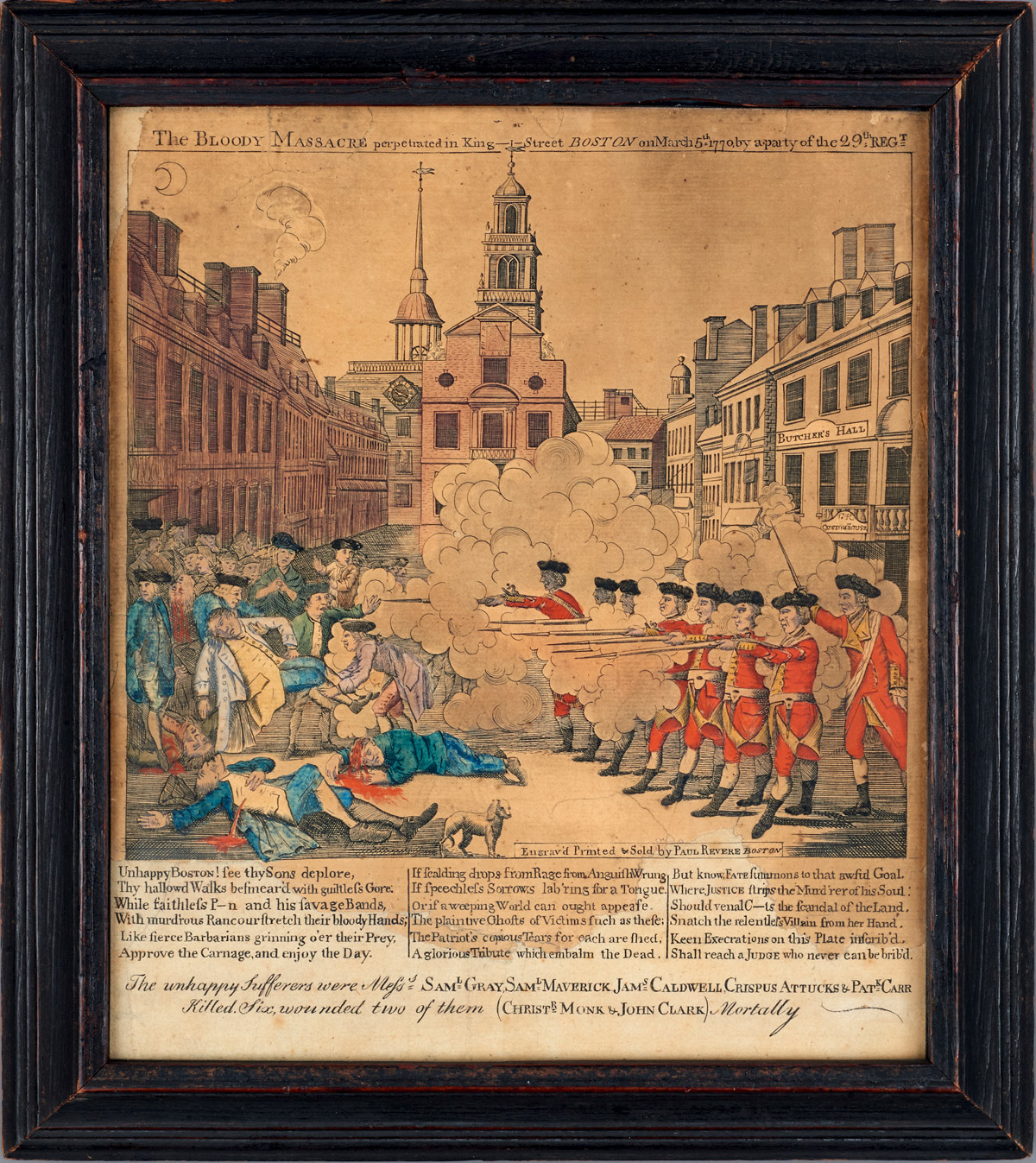
The Bloody Massacre, engraved by Paul Revere, Jr. (1734-1818), Boston, MA, 1770. Ink on paper. 0864.

Throughout the American War for Independence, scores of images circumnavigated the globe, fighting their own battles to establish a comprehensible narrative for the momentous events occurring in British North America. Differences in politics, disruptions in communication, and the delay of thousands of miles of distance produced competing and often contradictory accounts. Some images became enduring representations of the conflict. Others faded from memory.

Drawing from Historic Deerfield’s rich collection of Revolutionary-era materials, this exhibition explores the diverse ways that 18th-century individuals “pictured” or understood the Revolution as it unfolded. Looking across prints, drawings, maps, broadsides, portraits, powder horns, ceramics, and satirical cartoons, Picturing the Revolution highlights how images shaped local and global perceptions of the war: its landscapes, its actors, its causes, and its goals. Mining these complex visual records reveals the often-overlooked importance of pictures in the shift from revolt to revolution, and in envisioning a future for the new nation.

This exhibition has been made possible with support from the National Endowment for the Humanities and the Massachusetts Office of Travel & Tourism.